Sommaire
15V Xinshu 心俞 [心兪]

1. Dénomination
1.1. Traduction
| 心输 [心輸] Xīnshū | Point qui répond au cœur (Nguyen Van Nghi 1971) Point correspondant au Cœur (Pan 1993) Creux du Coeur (Lade 1994) Bei shu du Cœur (Laurent 2000) |
- Zhou Mei-sheng 1984 : xin heart shu pivot; convey.
- Xin : Cœur (Pan 1993); (Ricci 1990) : Cœur ; for intérieur, l'intime ; le Cœur considéré comme siège de la pensée, esprit ; pensée ; considéré comme siège de la vie affective ; disposition intérieure ; milieu ; centre (Guillaume 1995); représentation du Cœur en haut le “péricarde” ouvert, au milieu le viscère, en bas une représentation sommaire de l'aorte (Laurent 2000).
- Shu : transporter (Pan 1993); (Ricci 4462) : transporter, offrir (Guillaume 1995) ; transporter, faire écouler… Cf. Naoshu 10IG (Laurent 2000).
1.2. Origine
- Ling Shu, chapitre « Bei Shu » (Guillaume 1995).
1.3. Explication du nom
- Zhou Mei-sheng 1984 : Xinshu This point leads to the heart. It can be used to promote the function of vital energy and the circulation of blood, to calm the nerves and to relieve morbid panic or fear.
- Lade 1994 : le nom fait référence à la relation de ce point avec le Cœur. Creux évoque un récipient, ou un moyen de transport, par lequel passe le Qi circulant (voir V-13, fei shu).
- Laurent 2000 : Suwen 8 “Le corps est assujetti au Cœur comme un pays à son roi”. “Le Cœur est un Zang royal, en lui réside l'esprit”. Suwen 9 “Le Cœur est l'essence de la vie…”.
1.4. Noms secondaires
| Běi shū 北输[北輸] (1) | Laurent 2000 |
| Xīnzhīshū 心之输[心之輸] (2) | Laurent 2000 |
| Wǔjiāo zhījiān 五焦之间[五焦之間] (3) | Laurent 2000 |
- point du dos
- Shu du Cœur
- 5° intervalle du Sanjiao
1.5. Romanisations
- (EFEO et autres)
- (Wade-Giles et autres)
1.6. Autres langues asiatiques
- (viet)
- (cor)
- (jap)
1.7. Code alphanumérique
- VE15, 15V, 15VE (Vessie)
- BL15, B15, Bladder 15 (Bladder)
2. Localisation
2.1. Textes modernes
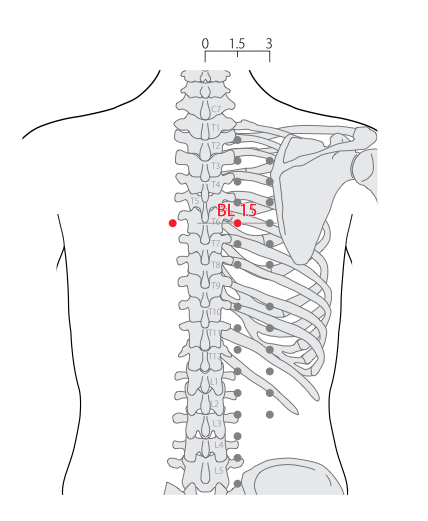
- Nguyen Van Nghi 1971 : A une distance et demie de la ligne médiane postérieure à hauteur du point Chenn Tao (11VG) au-dessous de la cinquième vertèbre dorsale
- Roustan 1979 : à 1,5 distance en-dehors de l'extrémité de l'apophyse épineuse de la cinquième vertèbre dorsale.
- Lu HC 1985 : Location-1: 1.5 cuns laterally from the lower end of the spinous process of the 5th thoracic vertebra. Location-2: On a level with the spinous processes of the 5th and 6th thoracic vertebrae, 1.5 cuns laterally from the posterior median line. How-to-locate-1: Locate this point 1.5 cuns laterally from the depression below the 5th thoracic vertebra. How-to-locate-2: Let the patient lie on stomach, locate this point below the 5th thoracic vertebra, on a level with and 1.5 cuns laterally from Shendao = D11.
- Deng 1993 : Sur le dos, au-dessous de l'apophyse épineuse de la cinquième vertèbre dorsale, à 1,5 cun de la ligne médiane postérieure.
- Pan 1993 : Xinshu est situé à 1,5 distance du point Shendao (11VG), sur la ligne horizontale passant au-dessous de l'apophyse épineuse de la cinquième vertèbre dorsale.
- Guillaume 1995 : À 1,5 distance en dehors du processus épineux de la cinquième vertèbre thoracique, dans le cinquième espace intercostal.
- Laurent 2000 : sur le dos, à 1,5 cun en dehors de la 5° épineuse dorsale, dans le 5° espace intercostal.
- WHO 2009: In the upper back region, at the same level as the inferior border of the spinous process of the fifth thoracic vertebra (T5), 1.5 B-cun lateral to the posterior median line.
Items de localisation
2.2. Textes classiques
- Ling Shu : De chaque côté de la cinquième vertèbre, et à 3 cun l'un de l'autre (Deng 1993).
- Jia Yi : Au-dessous de la cinquième vertèbre et à 1,5 cun de la ligne médiane (Deng 1993).
- Tu Yi : Au-dessous de la cinquième vertèbre et à 2 cun de la colonne vertébrale. On localise ce point lorsque le patient est assis, le buste redressé (Deng 1993).
- Deng 1993 : tous les anciens ouvrages de médecine s'accordent sur la localisation de ce point, et c'est la définition de Jia Yi qui prévaut actuellement. Xinshu (V15) est donc localisé sur le dos, au-dessous de l'apophyse épineuse de la cinquième vertèbre dorsale, et à 1,5 cun de la ligne médiane postérieure.
2.3. Rapports et coupes anatomiques
- Roustan 1979 : 5ème artère et veine intercostales posteriores, rami dorsales du 5ème nerf thoracicus, en profondeur, ramus cutaneus lateralis du 5ème nerf thoracicus.
- Deng 1993 : Peau—tissu sous-cutané—muscle trapèze—bord inférieur du muscle rhomboïde—muscle érecteur épineux. Dans la couche superficielle, on trouve les branches cutanées internes des branches postérieures des cinquième et sixième nerfs thoraciques, et les artères et les veines qui s'y rattachent. Dans la couche profonde, on trouve les branches musculaires des branches postérieures des cinquième et sixième nerfs thoraciques, et les branches ou tributaires des branches dorsales des artères et des veines intercostales postérieures correspondantes.
- Guillaume 1995 : Branche postérieure de l'artère et de la veine intercostales postérieures. Rameau médial de la branche dorsale de T5.
Rapports anatomiques 15V, 6MC et Coeur
- Chen Shulin et al. [Nervous Basis of Correlation between Neiguan (PC6), Xinshu (BL15) points and the Heart]. Chinese Acupuncture and Moxibustion. 1996;16(12):33. [55480].
The peripheral nervous connections between Xinshu (BL15), Neiguan (PC6) points and the heart in the rabbit were studied by hirse raddish peroxidase (HRP) retrograde tracing and fluorescent double labelling methods. The results show that the heart and Xinshu point connect directly with each other by divergent projections of the primary sensory neurons and there may be a direct or indirect connection between the sympathetic postganglionic neurons of innervating the heart and Neiguan point, besides connections through the central nervous system. The results provide a morphological evidence for mechanisms of correlation between acupoints and viscera.
2.4. Rapports ponctuels
3. Classes et fonctions
3.1. Classe ponctuelle
- Nguyen Van Nghi 1971 : Point spécifique de dispersion de l'énergie Yang du cœur. Fait partie du groupe des points pour disperser le Yang des cinq organes (voir Fei Iu, 13V). So Ouenn (Chapitre 52) : « Ne pas puncturer n'importe comment le Sinn Iu. Si on blesse le cœur, c'est la mort dans les 24 heures ; dans ce cas, le malade présentera des nausées. » Point employé dans la technique Iu-Mo pour traiter les affections du cœur (Iu du cœur : Sinn Iu, et le Mo du cœur Tu Chué (14VC).
- Pan 1993 : sur le méridien de la Vessie, on trouve les points appelés « points Shu du dos ». Ces points sont en rapport avec les organes et les entrailles ; c'est par ces points que les viscères sont mis en contact avec la surface externe du corps. Ces points servent à soigner le viscère correspondant et les éléments régis par ce viscère. Par exemple, parce que le Poumon régit la peau, le point Shu en rapport avec le Poumon (Feishu 13V) pourra être employé non seulement pour traiter les troubles pulmonaires, mais aussi pour soigner les maladies de peau.
- Pan 1993 : point Shu du dos correspondant au Cœur.
3.2. Classe thérapeutique
- Roustan 1979 : calme le cœur, traite le sang.
- Guillaume 1995 : Xinshu nourrit le Sang, calme le Shen, clarifie le Cœur, apaise le Zhi, élargit le thorax, régularise le Qi, vivifie les Luo, calme la douleur. Selon le Tai yi shen zhen, Xinshu ouvre l'orifice du Cœur, élimine la chaleur, calme l'Esprit, stabilise la volonté, tonifie le Cœur, active le Sang.
- Laurent 2000 : calme le Cœur, élimine la chaleur du Cœur, nourrit le sang du Cœur, restaure les Luo, supprime les stases de sang du Cœur.
4. Techniques de stimulation
| Acupuncture | Moxibustion | Source |
|---|---|---|
| Selon Tong ren, puncturer à 0,3 distance, laisser l'aiguille le temps de 7 expirations | Selon Tong ren ne pas faire de moxa. Selon Ming tang, appliquer 3 cônes de moxa. | Zhen jiu ju ying (Guillaume 1995) |
| Puncture inclinée entre 0,5 et 0,8 distance de profondeur | Cautérisation avec 3 à 5 cônes de moxa, moxibustion pendant 5 à 15 minutes | Guillaume 1995 |
| Piqûre perpendiculaire ou oblique de 0,5 à 1 cun | Chauffer 10 mn | Laurent 2000 |
| Piqûre perpendiculaire à 0,5-1 distance Piqûre sous-cutanée du haut vers le bas à 1-2 distances | Cautériser 3-5 fois, chauffer 5-15 minutes | Roustan 1979 |
Sensation de puncture
- Zhen jiu ju ying : Disperser dès l'obtention du Deqi (Guillaume 1995).
Sécurité
- Roustan 1979, Guillaume 1995 : Ne pas piquer trop profondément.
- Guillaume 1995: Selon le Zi sheng jing, si la puncture atteint le Cœur, le sujet meurt en un seul jour, il a le hoquet dès qu'il bouge. D'autres font remarquer qu'on ne peut puncturer ce point qu'avec prudence. Qian jin dit que, en cas d'attaque directe par le vent avec Xin ji (Cœur pressé), il faut appliquer 100 cônes de moxa sur Xinshu.
- Guillaume 1995 : Selon le Jia yi jing, ce point est interdit à la moxibustion. Selon Yi xue ru men, il est interdit à la puncture et à la moxibustion.
5. Indications
| Classe d'usage | ★★ | point majeur |
|---|
5.1. Littérature moderne
- Nguyen Van Nghi 1971 : Point à puncturer principalement dans les cas de : toux cardiaque, hématémèse, troubles mentaux, spermatorrhée nocturne, oubli facile, épilepsie
- Roustan 1979 : neurasthénie, névralgies intercostales, cardiopathie rhumatismale, tachycardie, schizophrénie, épilepsie, hystérie. Douleurs précordiales, toux, hémoptysie, vomissements, fièvre intermittente, chaleur à la paume de la main, spermatorrhée, transpiration nocturne.
- Lade 1994 :
- Régularise et tonifie le Cœur (surtout le Qi, le Yang et le Sang), Régularise le Réchauffeur Supérieur, tonifie le Qi Ancestral, clarifie le Feu et la Chaleur du Cœur, rafraîchit la Chaleur du Sang, transforme les Glaires du Cœur, et élargit et décontracte la poitrine. Indications : syndrome ménopausique, tuberculose pulmonaire, rhumatisme cardiaque, neurasthénie, mutisme, transpirations nocturnes, fièvre et frissons, toux avec ou sans expectoration de sang, épistaxis, douleur de la poitrine avec irritabilité et dépression, douleur de la poitrine irradiant vers le haut du dos, et sensation de chaleur dans les paumes des mains et les plantes des pieds.
- Calme l'Esprit, fortifie et clarifie le Cerveau, et transforme les Glaires-Vent. Indications : épilepsie, hystérie, hallucinations, dépression, pertes de mémoire, désorientation, sommeil perturbé par des rêves, insomnie, anxiété et palpitations, et pollutions nocturnes.
- Guillaume 1995 : Inquiétude intra-thoracique, palpitations, angoisse, douleur thoracique, toux, vomissement de sang, perte de mémoire, insomnie, spermatorrhée, transpiration subite, chaleur de la paume des mains et de la plante des pieds, folie-dian kuang, épilepsie ; dépression nerveuse, dédoublement de la personnalité, douleur intercostale.
5.2. Littérature ancienne
- Jia yi jing : « Accès de fièvre et de frissons, douleur du Cœur qui irradie vers le dos, difficulté à respirer, toux avec hémoptysie, hypersialorrhée, flatulence avec mauvaise haleine, inappétence, toux avec reflux ; absence de transpiration dans un état comparable à un accès pernicieux, vision trouble, larmoiement, tristesse », « Gonflement du Cœur-xin zhang », « Accès pernicieux-ji nue » (Guillaume 1995).
- Qian jin yao fang : « Vent du Cœur avec ballonnement et plénitude abdominale, indigestion, vomissement de sang, amaigrissement des quatre membres, Douleur-de l'épaule et du, flanc », « Inappétence, plénitude thoracique, reflux du Qi au-dessus du diaphragme avec sensation de flatulence et de chaleur », « Absence et hébétude-huang-hu », « Tristesse », « Sentiment de regret avec douleur vague, plénitude et reflux », « En cas d'attaque directe au niveau du Cœur, le sujet est obligé de s'allonger sur le dos, il ne peut pas se coucher sur le côté, il a une sensation d'inquiétude et de nervosité, transpiration », « Vent-froid du Cœur », « Ictère » (Guillaume 1995).
- Qian jin yi fang : « Maladie du Cœur », « Sentiment de regret au niveau du Cœur avec douleur discrète du dos » (Guillaume 1995).
- Ishimpo : Sensation de frissons et de fièvre ; douleur du Cœur ; douleur du dos ; douleur thoracique ; toux ; expectoration de sang ; hypersialorrhée ; nausée ; douleur oculaire ; larmoiement (Guillaume 1995).
- Sheng hui fang : « Attaque directe du Cœur par le vent, épilepsie-kuang xian, Qi du Cœur avec propos incohérents, tristesse et pleurs, plénitude épigastrique ; absence de transpiration, stagnation avec éruption maculeuse de type froid, vomissement et reflux, inappétence et vomissement de sang après le repas, douleur oculaire », « Sensation de plénitude à l'intérieur du Cœur, toux avec difficulté respiratoire, angoisse avec hypersialorrhée », « Lorsqu'un enfant de cinq à six ans ne parle pas encore, c'est que le Qi du Cœur est insuffisant, la racine de la langue est sans force et sa mobilisation est difficile », « Stagnation du Qi », « Dos de tortue des enfants (cyphose) » (Guillaume 1995).
- Tong ren : « Inquiétude et cafard-xin xiong men luan. » (Guillaume 1995).
- Shennong jing : « En cas d'insuffisance de Qi du nourrisson avec retard du langage, on peut faire 5 cônes de moxa de la taille d'un grain de blé. » (Guillaume 1995).
- Yu long fu : « Associé à Shenshu- 23V, il traite la faiblesse et le vide des lombes et des Reins avec pollution nocturne- Bai zheng fu « Associé à Shendao- 11VG, il traite l'épilepsie de type vent-feng xian. » (Guillaume 1995).
- Jie jing : « Xinshu traite l'obstruction du Qi par la tristesse-you ye. » (Guillaume 1995).
- Zhen jiu ju ying : hémiplégie, perturbation du Qi du Cœur avec absence et hébétude-huang hu, atteinte directe du Cœur par le vent, impossibilité de se coucher en décubitus latéral, anxiété et vertige avec tendance syncopale, transpiration, lèvres rouges, agitation avec crises convulsives-kuang zou fa xian, tristesse, pleurs, angoisse thoracique-xiong men luan, toux, vomissement de sang, ictère, myoclonies palpébrales, éblouissements, vomissements, inappétence, érysipèle, spermatorrhée, écoulement uréthral, perte de mémoire, insuffisance de Qi du Cœur du jeune enfant qui ne parle pas. » (Guillaume 1995).
- Da cheng : « Hémiplégie, perturbation du Qi du Cœur avec absence et hébétude-huang hu, atteinte directe du Cœur par le vent, impossibilité de se coucher en décubitus latéral, anxiété et vertige avec tendance syncopale, transpiration, lèvres rouges, agitation avec crises convulsives-kuang zou fa xian, tristesse, pleurs, angoisse thoracique-xiong men luan, toux, vomissement de sang, ictère, myoclonies palpébrales, éblouissements, vomissements, inappétence, perte de mémoire, insuffisance de Qi du Cœur du jeune enfant qui ne parle pas.» (Guillaume 1995).
- Xun jing : « Angoisse-xin xu jing ji, épilepsie-dian xian », « Les différentes chaleurs perverses qui atteignent le Cœur, perlèche ; le Sang du Cœur ne pénètre pas dans le Foie, il circule d'une manière désordonnée dans la partie supérieure et s'élimine par le bas » (Guillaume 1995).
- Lei jing tu yi : « Vent unilatéral-pian feng, dysphagie avec amas et nouure-ji jie, froid et chaleur ; perturbation du Qi du Cœur avec anxiété-xin qi men luan, plénitude épigastrique avec obnubilation-fan man huang hu, angoisse-xin jing avec absence de transpiration, attaque directe par le vent avec impossibilité de se coucher en décubitus latéral, accès de convulsions-fa xian avec tristesse et pleurs, vomissement, toux avec hémoptysie, accès de folie-fa kuang, perte de mémoire. Ce point est utilisé pour disperser la chaleur des Cinq Organes, son rôle est comparable à celui des points shu des Cinq Organes. D'après certains auteurs, ce point est utilisé pour traiter les vides du Cœur avec spermatorrhée et transpiration subite, il faut tonifier. » (Guillaume 1995).
- Wai ke da cheng : « Furoncles. » (Guillaume 1995).
- Tai yi shen zhen : « Accès de froid et de chaleur avec gêne intra-thoracique, Esprit troublé et état confus, peur, retard de la parole chez les enfants, chaleur des cinq centres, palpitations et insomnie. » (Guillaume 1995).
5.3. Associations
| Indication | Association | Source |
|---|---|---|
| Neurasthénie | 15V + 14VC (injection *) | Roustan 1979 |
| Arythmie | 15V + 7C + 6MC + 34VB | Shanghai zhen jiu xue (Guillaume 1995) |
| Palpitations | 15V + 18V + 20V + 7C + 40E | Si ban jiao cai zhen jiu xue (Guillaume 1995). |
| Cardiopathie rhumatismale | 15V + 14V | Roustan 1979 |
| Cœur pulmonaire | 15V + 7C + 40E | Roustan 1979 |
| Hébétude | 15V + 7C | Lei jing tu yi (Guillaume 1995) |
| Insomnie | 15V + 21V + 12VC + 7C + 40E | Zhong hua zhen jiu xue (Guillaume 1995) |
| Douleur oculaire | 15V + 28VG | Zi sheng jing (Guillaume 1995) |
| Toux avec hémoptysie | 15V + 18V + 12E + 14VC + 1VG | Zi sheng jing (Guillaume 1995) |
| Spermatorrhée | 15V+ 23V | Yu Long Ge (Roustan 1979), Zhen jiu ju ying-Yu long Fu (Guillaume 1995) |
*Injection de produits divers mais souvent très dilués : novocaïne, eau distillée, sérum physiologique… ou diverses drogues plus spécifiques.
5.4. Revues des indications
6. Etudes cliniques et expérimentales
6.1. Rythme cardiaque
- Liu Peng, Wang Qiang, Chen Zhi. [Therapeutic Observation of Heat-Producing Needling at Xinshu (BL 15) and Jueyinshu (BL 14) for Premature Heart Beat due to Heart-Yang Deficiency]. Shanghai Journal of Acupuncture and Moxibustion. 2014;33(11):1008. [184533].
Objective To observe the efficacy of heat-producing needling at Xinshu (BL 15) and Jueyinshu (BL 14) in treating premature heart beat due to heart-yang deficiency. Methods Totally 114 patients with premature heart beat due to heart-yang deficiency were randomized into group A, group B, and group C, 38 in each group. Group A was intervened by using heat-producing needling method at Xinshu (BL 15) and Jueyinshu (BL 14); group B was by acupuncture at Neiguan (PC 6), Shenmen (HT 7), Tongli (HT 5), Juque (CV 14), Danzhong (CV 17), etc. with moderate needling manipulations; group C was by using heat-producing needling method at Xuanzhong (GB 39) and Yanglingquan (GB 34). In all 3 groups, the treatment was given once per day, 10 sessions as a treatment course. Four courses later, the dynamic electrocardiogram (ECG) result and clinical efficacies were compared. Results The total effective rate was 76.3% in group A, significantly different from 3 1.6% in group B and 23.7% in group C (P< 0.01). By Ridit analysis, the change of disease grading in group A after intervention was statistically significant (P< 0.01); there were no significant changes in disease grading after intervention between group B and group C (P > 0.05). Conclusion Heat-producing needling at Xinshu (BL 15) and Jueyinshu (BL 14) is effective in treating premature heart beat due to heart-yang deficiency.
- Li Xuehui, Gao Xinzhu, Hu Ling. [Experimental Study on Synergetic and Antagonistic Effects of Acupoints “Neiguan”, “Shenmen” and “Xinshu]. Chinese Acupuncture and Moxibustion. 2002;22(12):819. [110266].
Purpose : To observe synergetic or antagonistic effects between points of similar effects. Methods : Ventricular arrhythmia rabbit model was induced by injection of aconitine, the duration of arrhythmia. was adopted as index and the differences of therapeutic effects of single application and combined application of “Neiguan!' (PC 6), ” Shenmen” (HT 7), “Xinshu” (BL 15) were investigated. Results : Single acupuncture of (PC 6), “ Shenmen” (HT 7) and “ Xinshu” (BL 15) has obvious and similar therapeutic effect, and combination of the 3 acupoints. did not significantly increase or decrease the therapeutic effect. Conclusion : The acupoints with similar actions do not have markedly synergetic or antagonistic effects.
- Xu LD, Zhang YX, Zheng YH. [Observation on Therapeutic Effect of Acupoint Sticking at Neiguan (PC 6) and Xinshu (BL 15) for treatment of Bradycardia]. Chinese Acupuncture and Moxibustion. 2010;30(3):192-4. [155723].
OBJECTIVE: To observe the therapeutic effect of acupoint sticking of Wuzhuyu (Evodia Rutaecarpa) for treatment of bradycardia. METHODS: Sixty cases were randomly divided into an observation group and a control group, 30 cases in each group. The observation group was treated with acupoint sticking of Wuzhugu (Evodia Rutaecarpa) at Neiguan (PC 6) and Xinshu (BL 15) once each day. The control group was treated with oral administration of Xinbao pills, 3 pills each time, thrice each day. The therapeutic effects and changes of 24 hours' holter were observed after 4 weeks.RESULTS: After treatment, 24 hours' average heart rate was significantly improved in the two groups, with significant differences as compared with those before treatment (both P<0.01) and with no significant difference between the two groups (P>0.05). The total effective rate was 86.7% (26/30) in the observation group and 83.3% (25/30) in the control group, their therapeutic effect being similar.CONCLUSION: Acupoint sticking of Wuzhugu (Evodia Rutaecarpa) can significantly raise the levels of 24 hours' average heart rate in the patients of bradycardia. This therapy and Xinbao pills have similar therapeutic effect on the improvement of clinical symptom and heart rate levels.
6.2. Coronaropathies
- Guo Li-Hong, Chen De-Sen, Fang Wei. [Protective Action of Acute Myocardial Ischemia in Rats by Electroacupuncturing Neiguan, Xinshu]. Journal of Clinical Acupuncture and Moxibustion. 2009;25(11):46. [172497].
Objective:To investigate protective action of acute myocardial ischemia in rats by electroacupuncture Neiguan, Xinshu. Methods: 50 rats were randomly divided into control group, model group, Neiguan group. Xinshu group and Guanshu group. Through the sublingual intravenous pituitrin copy rat model of acute myocardial ischemia were observed after electro-acupuncture treatment of rats in each group : standard lead-lead ECG to obtain heart rate, maximum left ventricular pressure rise rate and peak left ventricular systolic pressure, comparison of electro-acupuncture of different acupoints on acute myocardial ischemia in rat cardiac function and blood rheology. Results: After myocartlial ischemia, cardiac function of the mean. The absolute value of subscript values were significantly decreased. Electroacupuncture group, Guanshu group, Xinshu group on cardiac function and blood rheology improvement compared with the model group there were significant differences (P<0.05). There was a significant difference among Neiguan group, Xinshu group and Guanshu group (P<0.05).Conclusion: Electro-acupuncture on Xinshu and Neiguan can be significantly improved in rats with acute myocardial ischemia on cardiac function and blood rheology is also significantly affected, and the joint distribution point group Guanshu of the more obvious effects.
- Song Chun-Hua, Wang Shuang, Yang Long. [Effect of Pretreatment with Electroacupuncture at Xinshu (BL15) on Serum NO and CAT in Rats with Myocardial Ischemia-Reperfusion]. Shanghai Journal of Acupuncture and Moxibustion. 2012;31(4):277. [175530].
Objective To explore the effect of pretreatment with electroacupuncture at Xinshu (BL1 5) on serum NO and CAT in rats with myocardial ischemia-reperfusion. Method The rats were randomized into a normal control group, a model group, a control group, and an electroacupuncture pretreatment group, by comparing the pretreatment with acupuncture and ischemic precondition, to observe the contents of serum NO and CAT in the four groups. Result Pretreatment with electroacupuncture could increase the contents of NO and CAT in rat serum. Conclusion Pretreatment with electroacupuncture at Xinshu can protect the myocardium to some extent in myocardial ischemia.
- Li Meng Hu Ling Gao Xin-Zhu, et al. [Synergetic Protective Effect of Electro-Acupuncturing Neiguan and Xinshu on Acute Myocardial Ischemia in Rabbits]. Journal of Anhui Traditional Chinese Medical College. 2002;21(6):30. [110459].
Objective : To observe the synergetic protective effect of electro-acupuncturing Neiguan and Xinshu against acute myocardial ischemia in rabbits. Method : 40 rabbits were randomly divided into 5 groups, namely, control group, model group, Neiguan group treated with electro-acupuncture (EA) at Neiguan acupoint, Xinshu group treated with EA at Xinshu acupoint, Guanshu group treated with EA at both Neiguan and Xinshu acupoint. Injecting pituitrin into auricular vein simulated the rabbit acute ischemic electrocardiogram (ECG) - The changes of T wave and S-T segment of ECG were observed after treatment. Result : The improvement of T wave and S-T segment was the most in Guanshu group than that in any other group (P < 0. 05). The rehabilitation time of ischemic ECG was the shortest among 4 groups with acute ischemic ECG (P < 0. 05). Conclusion : EA at both Neiguan and Xinshu acupoint has synergetic protective effect against acute myocardial ischemia.
6.3. Insuffisance cardiaque
- Wang Jing, Zeng Yong-Lei, Wang Jie. [Clinical Study on Moxibustion at Feishu ( BL 13) and Xinshu (BL 15) for Chronic Heart Failure]. Shanghai Journal of Acupuncture and Moxibustion. 2012;31(2):91. [175479].
Objective To observe the treatment effect of moxibustion plus Western medication in treating chronic heart failure. Method Sixty patients were randomized into a control group and a treatment group, 30 in each. The control group was intervened by routine Western medication, and the treatment group was intervened by mild moxibustion at bilater Feishu (BL 13) and Xinshu (BL 15) by moxa stick in addition to the Western medication, 20 mmn for each acupoint, once a day, and 4-week moxibustion treatment was given in total. The clinical effect and the involved indexes of heart function were compared between the two groups after treatment. Result The total effective rate was 76.7% in the control group, versus 90.0% in the treatment group, and the result in the treatment group was markedly superior to that in the control group (P<0.05); both groups had obvious improvement in terms of FIR, CO and LVEF after treatment (P<0.0i), and the results of FIR, CO. and LVEF in the treatment group were significantly better than that! n the control group (P< 0.0!),and the improvement of the above terms in the treatment group was also better than that in the control group. Conclusion Compared with single Western medication treatment, combined moxibustion and Western medication obtains better treatment result in managing chronic heart failure.
6.4. Hyperthyroidie
- Cao Jinmei, Men Yanli, Fan Junming. [Clinical Observation on 262 Cases of Hyperthyoidism treated mainly by Catgut Embedding at Ganshu and Xinshu Points]. Chinese Acupuncture and Moxibustion. 2003;23(9):515. [118625].