Sommaire
20V Pishu 脾俞 [脾兪]

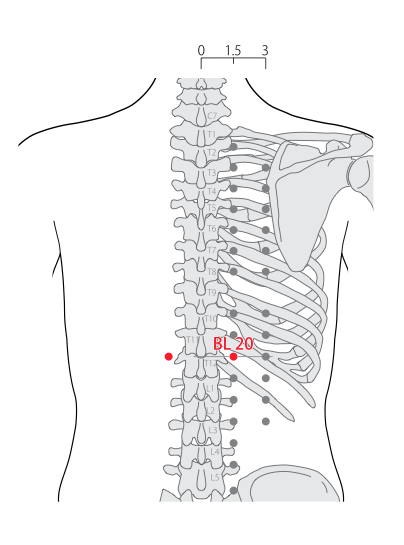
1. Dénomination
1.1. Traduction
| Píshū 脾输[脾輸] | Point qui répond à la rate (Nguyen Van Nghi 1971) Point correspondant à la Rate (Pan 1993) Creux de la rate (Lade 1994) Beishu de la Rate (Laurent 2000) |
|---|
- Pi : Rate (Pan 1993) ; (Ricci 3988) : Rate (Guillaume 1995) ; la Rate…Cf. Biguan 31E (Laurent 2000).
- Shu : transporter (Pan 1993) ; (Ricci 4462) : transporter, offrir (Guillaume 1995) ; transporter, faire écouler… Cf. Naoshu 10IG (Laurent 2000).
- Zhou Mei-sheng 1984 : pi spleen shu pivot; convey.
- Laurent 2000 : Même remarque qu'au point Biguan 31E: notez la similitude entre le caractère de la Rate 脾 (qui transforme et distribue “l'eau et les grains”) et le Bi 痺 des rhumatismes souvent liés à des problèmes d'humidité. Suwen 29 : “Les membres reçoivent de l'estomac un Qi devant passer par la Rate avant de gagner les méridiens. Si la rate est souffrante elle ne peut mettre en circulation les humeurs de l'Estomac et les membres sont privés de l'émanation des aliments, leur souffle s'afflaiblit de jour en jour, les voies du pouls s'imperméabilisent et les muscles, les os, les chairs deviennent inutilisables.”
1.2. Origine
- Ling shu, chapitre « Bei shu » (Guillaume 1995).
1.3. Explication du nom
- Zhou Mei-sheng 1984 : Pishu It leads to the spleen. This point helps the stomach with digestion.
- Lade 1994 : le nom fait référence à la relation de ce point avec la Rate. Creux évoque un récipient ou un moyen de transport par lequel passe le Qi circulant (voir V-13, Fei shu).
1.4. Noms secondaires
| Shíyī jiāo zhījiān 十一焦之间 [十一焦之間] (1) | Laurent 2000 |
|---|
- 11° intervalle du Sanjiao
1.5. Romanisations
- (EFEO et autres)
- (Wade-Giles et autres)
1.6. Autres langues asiatiques
- (viet)
- (cor)
- (jap)
1.7. Code alphanumérique
- VE20, 20V, 20VE (Vessie)
- BL20, B20, Bladder 20 (Bladder)
- UB 20 (Urinary bladder)
2. Localisation
2.1. Textes modernes
- Nguyen Van Nghi 1971 : A une distance et demie de la ligne médiane postérieure à hauteur du point Tsi Tchong (6VG).
- Roustan 1979 : à 1,5 distance en dehors de la pointe de l'apophyse épineuse de la onzième vertèbre dorsale (11ème espace intercostal).
- Lu HC 1985 : Location-1 : 1.5 cuns laterally from the lower end of the spinous process of the llth thoracic vertebra. Location-2 : On a level with the space between the spinous processes of the 11th and 12th thoracic vertebrae, 1.5 cuns laterally from the posterior median line. How-to-locate-1 : Locate this point 1.5 cuns from the depression below the llth thoracic vertebra. How-to-locate-2 : Let the patient lie on stomach, locate this point below the llth thoracic vertebra, 1.5 cuns away from Jizhong = D6.
- Deng 1993 : Sur le dos, au-dessous de l'apophyse épineuse de la onzième vertèbre dorsale, à 1,5 cun de la ligne médiane postérieure.
- Pan 1993 : Pishu est situé à 1,5 distance du point Jizhong (6VG), sur la ligne horizontale qui passe au-dessous de la onzième vertèbre dorsale.
- Guillaume 1995 : À 1,5 distance en dehors du processus épineux de la onzième vertèbre thoracique, dans le onzième espace intercostal.
- Laurent 2000 : sur le dos, à 1,5 cun en dehors de la 11° épineuse dorsale, dans le 11° espace intercostal.
- WHO 2009 : In the upper back region, at the same level as the inferior border of the spinous process of the 11th thoracic vertebra (T11), 1.5 B-cun lateral to the posterior median line.
Items de localisation (ensemble des items significatifs décrits dans la littérature permettant une localisation du point):
- Ligne médiane postérieure
- Apophyses épineuses de T11-T12
- Jizhong, VG6
2.2. Textes classiques
- Ling Shu : Au niveau de la onzième vertèbre,… et à 3 cun l'un de l'autre (Deng 1993).
- Jia Yi : Au-dessous de la onzième vertèbre et à 1,5 cun de la ligne médiane dessinée par la colonne vertébrale (Deng 1993).
- Tu Yi : Au-dessous de la onzième vertèbre et à 2 cun de celle-ci. On trouve ce point lorsque le patient est assis, le dos redressé (Deng 1993).
- Deng 1993 : tous les anciens ouvrages de médecine s'accordent sur la localisation de ce point, et c'est la définition de Jia Yi qui prévaut actuellement. Pishu (V20) est donc localisé sur le dos, au-dessous de l'apophyse épineuse de la onzième vertèbre dorsale et à 1,5 cun de la ligne médiane postérieure.
2.3. Rapports et coupes anatomiques
- Roustan 1979 : Rami dorsales des 11' artère et veine intercostalis, rami dorsales du 11ème nerf thoracicus.
- Deng 1993 : Peau—tissu sous-cutané—muscle grand dorsal—muscle dentelé postérieur et inférieur —muscle érecteur épineux. Dans la couche superficielle, on trouve les branches cutanées des branches postérieures des onzième et douzième nerfs thoraciques, et les artères et les veines qui s'y rattachent. Dans la couche profonde, on trouve les branches musculaires des branches postérieures des onzième et douzième nerfs thoraciques, et les branches ou tributaires des artères et des veines intercostales et sous-costales correspondantes.
- Guillaume 1995 : Branches postérieures de l'artère et de la veine intercostales postérieures. Rameau médial de la branche dorsale de T10.
2.4. Rapports ponctuels
3. Classes et fonctions
3.1. Classe ponctuelle
- Nguyen Van Nghi 1971 : Point spécifique de dispersion de l'énergie Yang de la rate. Fait partie du groupe de dispersion de l'énergie Yang des cinq organes (voir Fei lu, 13 V.). So Ouen (Chapitre 52) : « Si on puncture à tort la Pi Iu, on blessera la rate, il y aura des déglutitions incessantes et la mort surviendra dans les dix jours. » Point employé dans les affections de la rate par la technique lu-Mo : le point lu de la rate est le Pi Iu, le Mo de la rate est le Tchang Menn (13 F.).
- Point Shu du dos correspondant à la Rate (Pan 1993, Guillaume 1995)
3.2. Classe thérapeutique
- Roustan 1979 : traite l'énergie de la rate, chasse l'humidité.
- Guillaume 1995 : Pishu tonifie la Rate, élimine l'humidité, harmonise l'Estomac, abaisse les reflux. Selon le Tai yi shen zhen, Pishu tonifie la Rate et harmonise l'Estomac, élimine les ballonnements et favorise l'élimination de l'humidité, tonifie le Qi et renforce la constitution, facilite la digestion.
- Laurent 2000 : tonifie le Qi de la Rate, harmonise l'Estomac pour faire descendre les contre-sens (Ni), chauffé : tonifie le Yang de la rate, élimine l'humidité.
4. Techniques de stimulation
| Acupuncture | Moxibustion | Source |
|---|---|---|
| Selon Tong ren, puncturer à 0,3 distance, laisser l'aiguille le temps de 7 expirations | Appliquer 3 cônes de moxa ; 5 cônes, selon Ming tang | Zhen jiu ju ying (Guillaume 1995) |
| Puncture inclinée entre 0,5 et 0,8 distance de profondeur | Cautérisation avec 5 à 7 cônes de moxa, moxibustion pendant 10 à 20 minutes. | Guillaume 1995 |
| Piqûre perpendiculaire à 0,5-1 distance Piqûre sous-cutanée du haut vers le bas à 1-2 distances | Cautériser 3-7 fois, chauffer 5-20 minutes | Roustan 1979 |
| Piqûre perpendiculaire ou oblique de 0,5 à 1 cun | Moxas : 3 à 7 ; chauffer 30 à 60 mn | Laurent 2000 |
Sensation de puncture
Sécurité
- Roustan 1979 : Ne pas piquer trop profondément.
- Selon Su wen, si la puncture atteint la Rate, la mort survient en dix jours (Guillaume 1995).
5. Indications
| Classe d'usage | ★★ | point majeur |
|---|
5.1. Littérature moderne
- Roustan 1979 : gastrite, ulcère gastrique, ptose gastrique, vomissements neurologiques, dyspepsie, hépatite, entérite, œdème, anémie, maladies hémorragiques chroniques, ptose utérine, urticaire, asthénie. Hoquet, diarrhée, ictère.
- Lade 1994 :
- Régularise, fortifie et tonifie la Rate (surtout le Qi et le Yang), régularise l'Estomac (surtout le Qi et le Yin) et le Réchauffeur Moyen, nourrit la Sécheresse du Sang, tonifie le Qi Nourricier et le Sang, réduit les stagnations digestives, réchauffe le Froid, transforme l'Humidité, la Chaleur-Humidité (surtout de la Rate et de l'Estomac), les Glaires-Humidité et les Glaires-Froid, et assèche l'Humidité et le Froid-Humidité. Indications : syndrome de consomption avec soif du Réchauffeur Moyen, syndrome atrophique dû à la Chaleur-Humidité, strangurie de type Qi, troubles dysentériques, jaunisse de type Yin, hépatite, neurasthénie, ascite, gastrite, entérite, pancréatite, ulcères, gastralgie ou douleur épigastrique par Froid et vide de Qi de l'Estomac, perte d'appétit, mauvaise digestion, borborygmes, distension et douleur abdominales, œdème, dysfonction gastrique avec insomnie, urticaire, anxiété et palpitations dues au vide de Qi et de Sang, anémie, éblouissements et vertiges dus aux Glaires, rétrécissement œsophagien, vomissements, toux avec sécrétions abondantes, diarrhée aiguë ou chronique avec distension abdominale, constipation, selles avec aliments non digérés, et asthénie des membres.
- Retient le Sang. Indications : tous les types de saignement, en particulier saignements utérins anormaux et sang dans les selles.
- Ramollit les masses dures. Indications : augmentation de volume de la rate et du foie, masses abdominales dures, et lymphadénite.
- Élève le Qi Médian. Indications : prolapsus des organes (estomac, utérus, etc..).
- Active la lactation. Indications : lactation insuffisante par vide.
- Guillaume 1995 : Gastralgie, ballonnement abdominal, ictère, dysphagie, vomissement, diarrhée, diarrhée dysentériforme, élimination d'aliments mal digérés, œdèmes, ballonnement de l'abdomen qui est tendu comme un tambour, syndrome d'accumulation-xian pi ji ju, convulsions lentes des nourrissons-xiao er man jing feng, lassitude et douleur des épaules, du dos et des lombes ; gastrite chronique, spasmes gastriques, ptose gastrique, indigestion, hépatite, dysenterie bacillaire, néphrite, hémorragie chronique.
5.2. Littérature ancienne
- Jia yi jing : « Ballonnement abdominal responsable de douleur dorsale, amaigrissement malgré une alimentation correcte », « Gonflement de la Rate-pi zhang », « Aérocolie avec sensation d'un verre retourné à la palpation, chaleur responsable de douleur de l'Estomac », « Froid du Qi de la Rate avec inappétence », « Ictère avec tendance à bâiller. Plénitude au-dessous des flancs et nausée », « Contractures-convulsions dues à la chaleur-re ci » (Guillaume 1995).
- Qian jin yao fang : « Diarrhée dysentériforme avec indigestion et malabsorption », « Surmenage avec uréthrite », « Ballonnement plénitude et œdème », « Pesanteur du corps sans envie de bouger », « Douleur brutale et contracture des flancs », « Expectoration sanglante et vomissement de sang », « Contracture de la colonne lombaire », « Affections convulsivantes dues à la chaleur-re ci responsable de douleur de l'os » (Guillaume 1995).
- Qian jin yi fang : « Accès de frissons et de chaleur des quatre membres, lombalgie avec impossibilité de se pencher ou de se redresser, ictère avec plénitude abdominale, vomissement, raideur de la racine de la langue », « Hématurie » (Guillaume 1995).
- Wai tai mi yao : « Froid du Qi de la Rate, contracture des quatre membres, gène épigastrique avec inappétence » (Guillaume 1995).
- Ishimpo : Distension abdominale avec gaz responsable de douleur dorsale ; amaigrissement malgré une alimentation abondante ; bâillements fréquents ; inappétence ; plénitude intercostale ; besoin de vomir ; borborygmes ; sensation d'une tasse vide (à la palpation) ; spasmes aigus des extrémités et irritabilité (Guillaume 1995).
- Sheng hui fang : « Plénitude abdominale responsable de douleur dorsale, sensation de chaleur des quatre membres, tendance à s'allonger sans envie de se lever, absence d'envie de remuer les quatre membres », « Amas et accumulation-ji ju avec douleur abdominale, accès de frissons et de fièvre » (Guillaume 1995).
- Tong ren : « Sensation de plénitude sous les flancs », « Syndrome d'accumulation et de prise en masse-xian pi ji ju », « Accès fébrile dû aux glaires-tan nue » (Guillaume 1995).
- Zhen jiu ju ying : sa perturbation concerne la déglutition. Amaigrissement malgré une alimentation abondante, vomissement de liquide salé, syndrome d'accumulation et de prise en masse abdominale-xian pi ji ju, plénitude au-dessous des flancs, diarrhée, accès de fièvre dû aux glaires-tan nue avec frissons et chaleur, œdème-shui zhong, ballonnement dû aux gaz-qi zhang avec douleur de la colonne vertébrale, ictère, bâillements fréquents, inappétence (Guillaume 1995).
- Yi xue ru men : « Plénitude au-dessous des flancs, vomissement, diarrhée, diarrhée glaireuse, ballonnement abdominal, ictère, pesanteur du corps, masse intra-abdominale-xian pi, amas et accumulation-ji ju, douleur abdominale, frissons et fièvre qui provoquent une douleur de la colonne vertébrale, mange mais maigrit, raideur de la colonne lombaire, convulsions liées à la chaleur-re ci avec douleur des os » (Guillaume 1995).
- Da cheng : « Ballonnement abdominal avec douleur du thorax et du dos, amaigrissement malgré une alimentation abondante, syndrome d'accumulation et de prise en masse abdominale-xian pi ji ju, plénitude au-dessous des flancs, diarrhée, accès de fièvre dû aux glaires-tan nue avec frissons et chaleur, œdème-shui zhong, ballonnement dû aux gaz-qi zhang avec douleur de la colonne vertébrale, ictère, bâillements fréquents, inappétence » (Guillaume 1995).
- Xun jing : « Les cinq dysphagies et les cinq ictères, diarrhée et ictère de type Rate » (Guillaume 1995).
- Lei jing tu yi : « Tuméfaction, amas et accumulation-xian pi ji ju, plénitude au-dessous des côtes, maladie pernicieuse-xian nue avec frissons et fièvre, ictère, ballonnement et douleur abdominale, vomissement d'aliments et inappétence, indigestion, boulimie, anxiété et chaleur-fan re et tendance à s'allonger, amaigrissement régulier, diarrhée glaireuse, tendance à bâiller, corps lourd avec faiblesse des quatre membres. Ce point est utilisé pour disperser la chaleur des Cinq Organes, son rôle est comparable à celui des points shu des Cinq Organes. Selon certains, Pishu peut traiter l'œdème-shui zhong avec ballonnement de l'abdomen comparable à un tambour, plénitude de Qi-qi man avec diarrhée, tous ces symptômes étant chroniques, ainsi que les masses-ji kuai avec ballonnement et douleur chronique ». « Selon Qian jin, dans les diarrhées dysentériformes sans prise de poids, le ballonnement abdominal plénitude, l'œdème-shui zhong, il faut faire des moxas dont le nombre est fonction de l'âge. Dans le surmenage de type vide-Xu lao, l'hématurie et les uréthrites, il faut faire 100 moxas » (Guillaume 1995).
- Tai yi shen zhen : « Amas et accumulation-ji ju, dyspepsie et ballonnement abdominal, consumation du centre-zhong xiao, diarrhée, dysenterie, œdème » (Guillaume 1995).
5.3. Associations
| Indication | Association | Source |
|---|---|---|
| Diabète | 20V + 17V + 23V + Pi Re Xue (PN 101) | Roustan 1979 |
| Vide de Rate et indigestion | 20V + 28V | Zhen jiu ying-Bai zheng fu (Guillaume 1995) |
| Nausée | 20V + 21V + 12VC + 6MC + 36E + 6Rte | Zhong hua zhen jiu xue (Guillaume 1995) |
| Éructations | 20V + 21V + 12VC + 36E + 4Rte | Zhong hua zhen jiu xue (Guillaume 1995) |
| Ballonnement abdominal avec douleur à irradiation dorsale, amaigrissement malgré une alimentation abondante | 20V + 25V | Zi sheng jing (Guillaume 1995) |
| Diarrhée chronique | 20V + 12VC + 13F + 25E + 36E | Si ban jiao cai zhen jiu xue (Guillaume 1995) |
| Ictère | 20V + 5TR + 12VC | Qian jin (Guillaume 1995) |
| Leucopénie | 20V + 14VG + 36E + 6Rte | Roustan 1979, Shanghai zhen jiu xue (Guillaume 1995) |
| Chasser la Tristesse-bei | 20V + 19IG | Bai zheng fu (Guillaume 1995) |
| Œdème avec syndrome de vide | 20V + 23V + 9VC + 6VC + 6Rte + 36E + 39V | Zhong guo zhen jiu xue gai yao (Guillaume 1995) |
5.4. Revues des indications
- Yuan Cunxin et al. The Curative Effect and Mechanism of Action of the Acupoints Pishu and Weishu. Journal of Traditional Chinese Medicine. 1986;6(4):249-52. [20389].
- Yuan Cunxin et al. Studies on the Clinical Therapeutic Effect and Action Mechanism of Pishu (B 20) and Weishu (B 21) Points. Chinese Journal of Acupuncture and Moxibustion. 1988;1(3-4):28-31. [80582].
The clinical therapeutic effect and mechanism of 134.ck Shu (Pishu, Weishu) were studied since 1978. (1) The total effective rate in 70 cases with stomachache treated by needling Pishu, Weishu was 93.94%. There was significant difference as compared with the control group. (2) Among the 33 cases of subtotal gastrectomy and gastroduodenal ulcer before operation, there was 89.39% tenderness reactive points concentrated on pishu and Weishu and those points between them, rope from reactive mass could be touched in 53.03%. (3) A direct observation of the influence of needling Pishu and Weishu on the peristalsis of the stomach was performed by the application of fiber gastroscope. After needling, the rate of changes of movement of the stomach was 93.33%. There were significant differences as compared with the control group. In our observations, it was indicated that there may be relative regularities and specificities between Shu points and Zang Fu organs and function of the vegetative nervous system.
6. Etudes cliniques et expérimentales
6.1. Diabète
- Abdurachman. Laser Puncture Effect at Pishu (BL-20) Acupoint on STZ-Induced Diabetic Rats. European Journal of Integrated Eastern and Western Medicine. 2005;3(3):32. [142004].
In the present study, the effect of laserpuncture at pishu (BL-20) acupoint on 3 cell function repair in thl streptozotocin (STZ)-induced diabetic rats was investigated via blood glucose levels. Animais were randorril' divided into two groups: the control group was the STZ-induced diabetes group (n=13), and the STZ-inducei diabetes treated by laserpunctured group (n=14). From the results, the blood glucoselevels persisted at a high levE in the STZ-induced diabetic rats, while laserpuncture decreased blood glucoselevels significantly under diabeti, conditions. ln the present study, it can be suggested that laserpuncture treatment may modulate 13 cell functioi repair under diabetic conditions.
6.2. Gastralgies
- Zhou Conglian. Treating 40 Cases of Acute Stomach Ache by Electroacupuncture of Pishu and Weishu. International Journal of Clinical Acupuncture. 1993;4(2):189-90. [48703].
The main symptom of stomach ache, often seen in clinic, is upper abdominal pain. Acute and chronic gastritis, gastroduodenal ulcer, carcinoma of stomach, and gastroneurosis may all cause stomach ache. The author principally applied electroacupuncture of Pishu (UB20) and Weishu (UB21) to treat 40 cases of acute stomach ache. The results were satisfactory, as reported below.
- Wang Ke-Ming, Zhou Mei-Qi, Wang Yue-Lan, et al. [Effect of Electroacupuncturing Pishu on Electroactivity of Gastrointestinal Smooth Muscle in Gastric Ulcer Rats and its Mechanism]. Journal of Anhui Traditional Chinese Medical College. 2003;22(6):29. [123769].
6.3. Diarrhées
- Zhang Ling-lu. [Therapeutic Observation of Moxibustion at Pishu (BL20) for Chronic Diarrhea in Kids]. Shanghai Journal of Acupuncture and Moxibustion. 2016;35(6): 697-699. [191622].
Objective To observe the clinical efficacy of moxibustion at Pishu (BL20) in treating chronic diarrhea in kids, and to provide clinical evidence for the treatment of kid’s chronic diarrhea. Method Eighty-seven patients with chronic diarrhea were randomized into a treatment group and a control group. The control group was intervened by regular treatment, while the treatment group was by moxibustion at Pishu in addition to the intervention given to the control group. The serum immunoglobulin (Ig) A, IgM, IgG, and secretive immunoglobulin (sIgA) were compared before and after intervention. Result After intervention, there were significant differences in comparing IgA, IgM, IgG, and sIgA between the two groups (P<0.05); the recovery plus markedly-effective rate was 58.1% in the treatment group versus 34.1% in the control group, and the difference was statistically significant (P<0.05); the total effective rate was 100.0% in the treatment group versus 88.6% in the control group, and the difference was statistically significant (P<0.05). Conclusion Moxibustion at Pishu can regulate the function of spleen and stomach, enhance the body resistance to disease, and produce a satisfactory efficacy in treating kid’s chronic diarrhea.
6.4. Ostéporose post-ménopausique
- Liu Lan-Ying, Lin Zhi-Wei, Liu Xian-Jun. [The Effect of Catgut - Embedding Therapy in Pishu and Shenshu on Endocrine Hormone of Women with Primary Osteoporosis]. Journal of Clinical Acupuncture and Moxibustion. 2011;27(4):32. [174428].
Objective: Through observing the change in the level of serum estradiol (E2) , testosterone (T) and parathyroid hormone (PTH), to investigate clinical efficacy of catgut - embedding therapy in pishu and shenshu on the change of endocrine hormone of women with primary osteoporosis. Methods: Sixty women patients with primary osteoporosis were randomly assigned into acupoint catgut - embedding (n = 30) group and acupuncture group (n =30) , 6 weeks after treatment , patients were evaluated with the level of serum estradiol (E7), testosterone (T) and parathyroid hormone (PTH). Results: ())E2 , T: Compared with baseline data, serum estradiol ( E9) and testosterone (T) of both groups after treatment are increased and significant differences were showed in both groups (P <0. 05). There were not significant differences between the two groups ( P > 0. 05) ;② PTH: Compared with the data before the treatment, both groups were not significant differences after the treatment ( P > 0. 05.). There were not significant differences between acupoint catgut - embedding group and acupuncture group (P > 0. 05). Conclusion: Both acupuncture and acupoint catgut - embedding therapy in pishu and shenshu can make the level of serum estradiol (E2) and testosterone (T) of women with primary osteoporosis rise after 6 weeks treatment. The level of parathyroid hormone (FF11) is not strongly influenced by the two types treatments. The mechanism of clinical efficacy of acupuncture and acupoint catgut - embedding methed in pishu and shenshu for primary osteoporosis depends on increasing the level of serum estradiol (E2) and testosterone (T).
6.5. Myasthénie
- Zhang Lide et al. [Effect of Points Pishu and Yangling Quan-Moxibustion on Neuromuscular Transmission in a Rat Model of Myasthenia Gravis]. Shanghai Journal of Acupuncture and Moxibustion. 1998;17(2):39-41. [58067].
The effect of points Pishu (B21) and Yanglingquan (G34)-moxibustion was observed in the preparation of phrenic nerve-diaphragm in a rat model of myasthenia gravis (MG) and its mechanism was investigated. The findings showed that in the preparation, moxibustion on point Pishu (B21) or Yanglingquan (G34) increased the amplitude of miniature end-plate potential (MEPP) but had no obvious effect on acetylcholine potential (AchP), serum acetylcholine receptor antibody (AchRAb) titer and MEPP frequency ; moxibustion on both the points enhanced MEPP and AchP amplitudes and reduced serum AchRAb titer. Moxibustion on point Zusanli (S36) had no such effects. The above results indicate that moxibustion on points Pishu (B21) and Yanglingquan (G34) has a promoting effect on neuromuscular transmission in a MG rat, which is obtained possibly through reducing AchRAb titer and increasing the affinity between acetylcholine receptor at the end-plate membrane of skeletal muscle and acetylcholine.
6.6. Orgelet
- Pan H. [Blood-Letting Puncture at Pishu (BL 20) as Main for Stye]. Chinese Acupuncture and Moxibustion. 2011;31(9):782. [161748].
6.7. Pneumonie
- Wang Hong-yan, Zhao Qin, Li Peng-fei, Su Qing-lun,Wang Ping. [Effect on Immune Function and Clinical Efficacy of Cupping on Feishu, Pishu and Shenshu in the Treatment of Children Suffering from Mycoplasma Pneumonia] Journal of Clinical Acupuncture and Moxibustion. 2015;31(7):48. [188062].
Objective : To observe the influence of immune function and clinical efficacy of cupping on Feishu, Pishu and Shenshu(BLI 3,20 and 23)in the treatment of children suffering from mycoplasma pneumonia. Methods :60 children patients were randomly divided into two groups. The control group receivecl the traditional westem medicine including anti-infection , relieving cough and reducirig sputum and nebulizer treatnient ; while the treatment group added cupping on BLI 3 ,20 and 23 on the basis of the therapy in the control group. Then compare two groups according to disappearing time of coughing and lung' s rale , and the influence on patients' imn3une function. Results : The indexes'humora1 immunity:There was no difference of the leveis of IgA and IgG in two groups before and after treatment, and there was a statistically significant difference of the levels of IgM in the treatment group before and after treatment (P < 0. 05). The indexes of cell immunity: There was no statistical difference of the proportion of CD3 + cells in two groups before and after treatment. There was a statistically significant difference of the proportion of CD3+CD4 +,CD3+ CD8' and CD4+/CD8' cells in the treatment group before and after treatment ( P<0.05).Inflammatory indexes: there was a statistically significant difference of the levels of hs-CRP in two groups before and after treatmet(P <O. 05).The indexes of clinical evaluation: there was a statistically significant difference of disappearing time on coughing and lung's rale in two groups before and after treatmet( P <0. 05).Conclusion: The therapy of cupping on BLI3 ,20 and 23 for treating mycoplasma pneumonia in ehildren can obviousiy shorten the time of treatment and improve children'simmune function. This therapy is worth promoting.
6.8. Médecine Vétérinaire
- Wei Xubin et al. Observations on the Immunological Reactions by Laser Stimulation on Pishu of Cervine. Second National Symposium on Acupuncture and Moxibustion, Beijing. 1984;148. [2959].
6.9. Voies afférentes
- Tao Zhili et al. [Segmental Distributions of Sensory Neurons of the “Ganshu”, “Pishu”, “Liangmen”, “Qimen” Points and the Gallbladder]. Acupuncture Research. 1991;16(1):61. [64011].
One hundred guinea pigs were used. The 10% HRP 50-60 µl solution was injected into the acupoints of Ganshu (U. B. 18), Pishu (U. B. 20), Liangmen ((St 21) and Qimen (Liv 14) of every animal. Moreover, the 10% HRP 80-100 solution was injected into the gallbladder of the other animals too. Under the microscope, observed the segmental distributions of sensory neurons of the four acupoints and the gallbladder. It could be found much clearly that HRP labelled cells were appearing in the spinal ganglions. The above experimental studies showed that there are mutual intersect 5-7 segments between the gallbladder and the Ganshu, Pishu, Liangmen and Qimen four acupoints. It is probable that the mutual intersect is the neuroanatomic foundation of acupuncture and moxibustion to inhibit the formation of bilirubin gallstones.