Sommaire
6MC Neiguan 內关 (內關)

1. Dénomination
1.1. Traduction
| Nèiguān 内关 [內關] | Barrière interne (Nguyen Van Nghi 1971, Lade 1994) Passe importante pour communiquer avec l’intérieur (Pan 1993) Obstruction interne (Laurent 2000) |
|---|
- Zhou Mei-sheng 1984 : nei in the diaphragm; the inner side of the forearm; inner guan block; passage.
- Nei : intérieur (Pan 1993) ; Ricci 3618 : intérieur, interne, dedans (Guillaume 1995) ; interne, dedans, à l'intérieur… Cf. 44E neiting (Laurent 2000)
- Guan : passe de montagne (Pan 1993) ; Ricci 2788 : barre de bois servant à fermer la porte ; fermer, clore, obstruer, boucher ; barrière, poste-frontière, passe, défilé, douane, clé, organes vitaux ; concerner, mettre en rapport (Guillaume 1995) ; barrière, clore, obstruer… Cf. 7E xiaguan (Laurent 2000)
1.2. Origine
- Ling shu, chapitre « Jing mai ». (Guillaume 1995)
1.3. Explication du nom
- Zhou Mei-sheng 1984 : Neiguan Name of a disease (referred to as diaphragm block). This point is at an important place on the inner side of the forearm, it has the function of curing diseases of diaphragm block such as vomiting and hiccuping. This point corresponds to Waiguan (outer)(10TR), the two points are interrelated. It dwells in both Taiyin and Shaoyin, it is an important place connecting Hand Jueyin and Shaoyang.
- Pan 1993 : Passe importante pour communiquer avec l'intérieur. C'est le point Luo du méridien du Péricarde et le point Bamai jiaohui du Vaisseau merveilleux Yinweimai. La fonction du Yinweimai est de relier les méridiens Yin. Le point neiguan est un point aussi important qu'une passe de montagne pour communiquer avec l'intérieur du corps. On peut traiter certaines affections internes par ce point.
- Lade 1994 : le nom fait référence au rôle du point en tant que porte ou de point de Communication avec le méridien du Triple Réchauffeur et le Vaisseau de Liaison du Yin. Interne fait référence à la face palmaire de l'avant-bras et à la localisation du point sur un méridien Yin. Ce point est le pendant de TR-5 (wai guan), Barrière Externe.
- Laurent 2000 : habituellement ce point est traduit par “barrière interne”, mais le sens de guan est mettre une pièce de bois en travers d'une porte, donc obstruer ; neiguan traite précisément toutes les sensations d'obstruction. Le point étant situé entre les deux tendons palmaires pourrait justifier l'appellation “passe interne”.
1.4. Noms secondaires
| Yīn wěixué (1) 阴维穴 [陰維穴] | Selon Zhen jing zhi non (Guillaume 1995) |
|---|
Yin wei xue (selon Zhen jing zhi non) Yin wei : nom du méridien curieux.
- Yin Ricci 5789 du couple Yin-Yang, Wei Ricci 5512 : fibre, filament, lier, attacher, joindre, unir, principe fondamental, maintenir, sauvegarder, préserver, Xue Ricci 2101 : caverne, grotte, cavité, trou.
1.5. Autres Romanisations et langues asiatiques
- (fra.)
- (eng.)
- (viet.)
- (cor.)
- (jap.)
1.6. Code alphanumérique
- 6 MC, 6PC (Péricarde), 6 XB (Xinbao)
- PC 6,
- CS 6
2. Localisation
2.1. Textes modernes
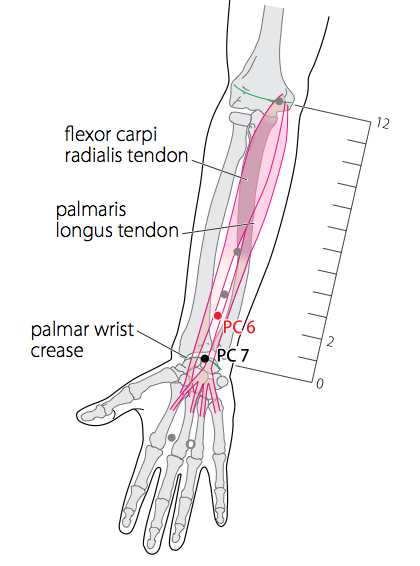
- Nguyen Van Nghi 1971 : À la face antérieure de l'avant-bras à 2 distances du pli du poignet où se trouve le point Taé Ling (7MC).
- Roustan 1979 : A deux distances au-dessus du milieu du pli antérieur du poignet, entre petit et grand palmaires.
- Deng 1993 : Sur la face palmaire de l'avant-bras et sur une ligne reliant Quze (Péric.3) et Daling (Péric.7 ), à 2 cun au-dessus de la pliure du poignet, entre les tendons du muscle petit palmaire et ceux du muscle fléchisseur radial du poignet.
- Guillaume 1995: À 2 distances au-dessus de Daling- 7MC, entre le tendon du grand palmaire et celui du petit palmaire.
- Laurent 2000 : sur la face antérieure de l'avant-bras, à 2 cun au-dessus de daling 7MC, dans l'espace entre les tendons palmaires.
- WHO 2009: On the anterior aspect of the forearm, between the tendons of the palmaris longus and the flexor carpi radialis, 2 B-cun proximal to the palmar wrist crease. Note 1: With the fist clenched, the wrist supinated and the elbow slightly flexed, the two tendons become more prominent. PC6 is located 2 B-cun proximal to PC7. The posterial point corresponding to PC6 is TE5. Note 2: If the palmaris longus tendon is not present, PC6 is medial to the flexor carpi radialis tendon.
2.2. Textes classiques
2.3. Rapports anatomiques
- Guillaume 1995: Veine médiane de l'avant-bras, artère et veine interosseuses antérieures. Nerf antébrachial cutané latéral du musculo-cutané, rameau cutané palmaire du nerf médian, nerf médian, nerf interosseux antérieur.
Rapports anatomiques 15V, 6MC et Coeur
- Chen Shulin et al. [Nervous Basis of Correlation between Neiguan (PC6), Xinshu (BL15) points and the Heart]. Chinese Acupuncture and Moxibustion. 1996;16(12):33. [55480].
The peripheral nervous connections between Xinshu (BL15), Neiguan (PC6) points and the heart in the rabbit were studied by hirse raddish peroxidase (HRP) retrograde tracing and fluorescent double labelling methods. The results show that the heart and Xinshu point connect directly with each other by divergent projections of the primary sensory neurons and there may be a direct or indirect connection between the sympathetic postganglionic neurons of innervating the heart and Neiguan point, besides connections through the central nervous system. The results provide a morphological evidence for mechanisms of correlation between acupoints and viscera.
3. Classes et fonctions
3.1. Classe ponctuelle
- Nguyen Van Nghi 1971 : Point Lo du méridien d'où partent les vaisseaux Lo. Le Lo transversal communique avec le point Iunn du méridien principal du triple réchauffeur (Yang Tcheu 4TR). Point d'ouverture du méridien curieux Inn Oé. Ling Tchou (Chapitre 66) : « Quand les énergies perverses (vent, froid, chaleur…) attaquent l'homme… si elles se logent dans les méridiens, ceux-ci sont obstrués ; on le verra au point Lo : Nei Koann (6MC), Oé Koann (5TR), Tron Li (5C), Li Tsiué (7P), Tché Tchong (7IG), Penn Li (6IG) » (voir étude des vaisseaux Lo.)
- Pan 1993: Point Luo du méridien Shoujueyin Péricarde; point Bamai Jiaohui du Vaisseau merveilleux Yin Wei mai.
- Guillaume 1995: Il s'agit du point luo du méridien Shoujueyin, c'est également un des points clés des huit méridiens curieux, il communique avec Yinweimai.
- Laurent 2000 : point “clé” du Yinweimai, point luo.


3.2. Classe thérapeutique
- Guillaume 1995: Neiguan purifie la chaleur, élimine l'inquiétude, élargit le thorax, harmonise le Qi, abaisse le reflux, arrête les vomissements, régularise l'Estomac, calme les douleurs. Selon le Tai yi shen zhen, Neiguan élargit le thorax et régularise le Qi, calme l'Esprit et harmonise l'Estomac , purifie et draine les Trois Foyers et le Feu du Cœur.
- Laurent 2000 : communique avec le yinwei, agit sur les Foyers Moyen et Supérieur, élimine le feu du Cœur, régularise l'Estomac, arrête les vomissements, élargit le thorax, traite les tensions émotionnelles, (associé au 14F jinmen et au 34VB yanglingquan) apaise le Foie et permet la régularisation de l'Estomac, fait descendre l'énergie. Traite les Symptômes de la branche luo : Plénitude : douleur au Cœur, Vide : angoisses.
4. Techniques de stimulation
| Acupuncture | Moxibustion | Source |
|---|---|---|
| Puncture perpendiculaire entre 0,5 et 0,8 distance de profondeur | Cautérisation avec 3 à 5 cônes de moxa, moxibustion pendant 5 à 10 minutes | Guillaume 1995 |
| Piqûre perpendiculaire de 0,5 à 1 cun | Moxas : 3 à 5; chauffer 10 à 20 mn | Laurent 2000 |
Sensation de puncture
5. Indications
| Classe d'usage | ★★ | point essentiel |
|---|
5.1. Littérature moderne
- Lade 1994 :
- Régularise et tonifie le Cœur (surtout le Qi, le Yang, le Sang et le Yin), transforme les Glaires du Cœur, facilite la circulation du Qi, régularise le Vaisseau de Liaison du Yin, et clarifie le Feu du Cœur. Indications : rhumatisme cardiaque, hyperthyroïdie avec transpiration excessive, douleur de la poitrine, douleur et choc (surtout post-chirurgical), asphyxie par noyade, palpitations, et sensations vertigineuses.
- Calme l'Esprit et clarifie le Cerveau, et disperse les Glaires-Vent. Indications : syndrome de collapsus, forme occluse de l'Attaque-de-Vent, démence, hystérie, épilepsie, hyperthyroïdie avec transpiration excessive, sensation de suffocation dans la poitrine, dépression avec plénitude de la région épigastrique, pertes de mémoire, et insomnie.
- Régularise le Foie (surtout le Qi), l'Estomac et le Réchauffeur Médian, fait circuler le Qi du Foie, clarifie le Feu et la Chaleur, vivifie le Sang, transforme l'Humidité, l'Humidité-Chaleur de l'Été et les Glaires, calme le fœtus et soulage la douleur. Indications : troubles paludéens, troubles dysentériques, agitation du fœtus par stagnation du Qi du Foie, insuffisance nutritionnelle des enfants avec vomissements, maladies aiguës des voies biliaires, jaunisse, pancréatite, appendicite, migraines, nausées, douleur et distension de l'épigastre, douleur de l'hypochondre, diarrhée avec vomissement, état nauséeux de la grossesse, et menstruations irrégulières.
- Fait descendre le Qi rebelle, élargit et décontracte la poitrine, et est bénéfique pour le diaphragme. Indications : asthme, bronchite, coqueluche, hoquets, vomissement, spasme du diaphragme, névralgie intercostale, douleur et plénitude de la poitrine, et dyspnée.
- Expulse les calculs biliaires.
- Active et facilite la lactation. Indications : lactation insuffisante par plénitude, et mastite aiguë.
- Effet local : contracture et douleur du coude et du bras.
- Illustration of Channels and Points 1992 : Rheumatic heart disease, shock, stenocardia , phrenospasm, epilepsy, hysteria, hyperthroidism, asthma, malaria, apoplexy. Cardiac pain, palpitation,
vomiting, chest pain, abdominal pain, migraine, sore throat, jaunndice, pain after operations, prolapce of rectum, disharmony of spleen and stomach.
- Guillaume 1995: Palpitations, douleur du Coeur, douleur du thorax et des flancs, vomissements, éructations, douleur de l'estomac, maladie pernicieuse-nue ji, vertige, folie-dian kuang, maladies convulsivantes-xian zheng, perte de mémoire, insomnie, douleur du coude et du bras, paresthésie des mains ; arythmie, angine de poitrine, cardiopathie rhumatismale, tachycardie paroxystique, insuffisance cardiaque, syndrome sans pouls, dépression nerveuse, mélancolie, gastro-entérite, névralgie intercostale.
5.2. Littérature ancienne
- Ling shu : Chapitre « Jing mai » : « En cas de plénitude : douleur du Coeur. En cas de vide : raideur de la tête (nuque) ». (Guillaume 1995)
- Jia yi jing : « Faciès rouge avec chaleur de la peau, maladie de la chaleur avec absence de transpiration, attaque par le vent-chaleur, yeux rouges et jaunes, contracture du coude et enflure axillaire, douleur du Coeur brutale en cas de plénitude, inquiétude- fan xin en cas de vide, angoisse du Coeur avec impossibilité de bouger, perte de la raison. » « Angoisse avec peur, tristesse. » (Guillaume 1995)
- Qian jin yao fang : « Attaque des mains par le vent-chaleur. » (Guillaume 1995)
- Ishimpo : “Faciès rouge ; sensation de chaleur de la peau ; maladie de la chaleur ; absence de transpiration ; affliction ; douleur aiguë du Coeur ; apoplexie ; fièvre ; coloration rouge et jaune des yeux ; contracture du bras ; enflure axillaire.” (Guillaume 1995)
- Yu long jing : « Blessure par le froid- shang han avec fièvre », « ictère de type Rate avec formation de masse- pi kuai », « stagnation des aliments, toux, asthme », « fistule anale, les Cinq Lin ».“ (Guillaume 1995)
- Yu long ge : « Amas de Qi- qi kuai dans l'abdomen. » (Guillaume 1995)
- Shennong jing : « Nei guan traite la douleur du Coeur avec ballonnement abdominal, les différentes maladies de l'abdomen, faire 7 cônes de moxa.» (Guillaume 1995)
- Yu long fu : « Associé à Zhao hai- 6Rn, il traite les masses- kuai à l'intérieur de l'abdomen.” (Guillaume 1995)
- Xi hong fu : « Associé à Gong Sun- 4Rte, il traite les douleurs abdominales. » (Guillaume 1995)
- Lon jiang fu : « Lorsqu'on traite le Coup de Froid- shang han au quatrième jour avec atteinte du méridien Tai yin, il faut d'abord utiliser Zhao hai- 6Rn, Gong sun- 4Rte puis Nei guan- 6MC. » (Guillaume 1995)
- Bai zheng fu : « Associé à Jian li- 11VC, il peut éliminer la sensation d'inquiétude à l'intérieur du thorax- ku men. » (Guillaume 1995)
- Biao you Fu : « Dans la pénitude du thorax avec douleur abdominale, puncturer Nei guan- 6MC. » (Guillaume 1995)
- lie fa : douleur des deux flancs à type de piqûre, vomissements incoercibles, vide de Qi de la Rate et de l'Estomac, ballonnement plénitude du Coeur et de l'abdomen (épigastre), douleur au-dessous des flancs et des côtes, douleur pongitive du Coeur et de l'abdomen, masse d'aliments-fu kuai shi jing qui ne se dissipe pas, amaigrissement progressif, masse de Sang-xue kuai, tuméfaction de Qi- qi jia, froid du vide des Organes et des Entrailles, stagnation du vent, stagnation du Qi, froid vide du Gros Intestin, prolapsus rectal, difficulté de défécation, toxique des Organes-zang du avec gonflement et douleur, hémorragie par voie basse !ors de la défécation qui ne cède pas, cinq hernies-wu shan, cinq épilepsies-wu xian, rejet de glaires et de salive par la bouche, désorientation, peur-xin jing, accès de folie-fa kuang, tristesse-bei et pleurs, défaut de reconnaissance de l'entourage, perte de mémoire, propos incohérents, chante ou rit sans raison, absence de quiétude, attaque directe par le vent-zhong feng avec perte de connaissance, Vide de Coeur, froid de la Vésicule biliaire, tremblements des quatre membres. Dans tous ces tableaux, le point Nei guan- 6MC est à prendre comme point principal ; associer d'autres points selon les symptômes. » (Guillaume 1995)
- Zhen jiu da quan : « Plénitude du Réchauffeur moyen avec sensation de malaise, Blessure par le froid- Shang han de la région épigastrique », « Plénitude et masse-pi man au niveau du Réchauffeur moyen, douleur pongitive des deux flancs », « Froid-vide de la Rate- Estomac, vomissements incessants », « Vide de Qi de la Rate-Estomac, ballonnement plénitude du Coeur et de l'abdomen », « Douleur sous les côtes et les flancs, douleur à type de piqûre de la région épigastrique », « Masse- pi kuai qui ne se dissipe pas », « Accumulation de nourriture et formation de masse-jie de Sang, douleur sourde de l'abdomen », « Prolapsus rectal qui ne se réduit pas », « Difficulté de défécation », « Rectorragie continuelle », « Les cinq maladies hémorroïdaires », « Les cinq convulsions-wu xian », « Perte de connaissance », « Accès de folie-kuang », « Palpitations et peur », « Peur avec attaque par le vent et perte de connaissance ». (Guillaume 1995)
- Zhen ju ying « Selon Tong ren, puncturer à 0,5 distance, appliquer 3 cônes de moxa. Indications : maladie vent-chaleur de la main, désorientation-shi zhi, douleur du Coeur, rougeur des yeux, distension thoracique, contracture du coude ; douleur brutale du Coeur en cas de plénitude, il faut disperser ; raideur de la nuque en cas de vide, il faut tonifier. Selon les commentaires, la plénitude et le vide concernent le méridien. » (Guillaume 1995)
- Yi xue ru men : « Chaleur et rougeur du visage, vue trouble, rougeur des yeux, distension du thorax, attaque directe par le vent-zhong feng, contracture du coude. En cas de plénitude : douleur brutale du Coeur. En cas de vide : inquiétude et angoisse. » (Guillaume 1995)
- Da cheng : Reprend intégralement la citation du Zhen jiu ju ying. (Guillaume 1995)
- Xun jing : « L'Estomac se retourne et reflux du Qi du diaphragme, plénitude du Réchauffeur moyen avec sensation de fermeté et ballonnement, dysharmonie de la Rate et de l'Estomac, diverses affections des Organes et des Entrailles, du thorax et des flancs. Il traite également les épilepsies-dian xian, les folies, les masses abdominales-pi kuai, les accès pernicieux-nue ji.» (Guillaume 1995)
- Lei jing tu yi : « Attaque directe par le vent-zhong feng avec perte du Zhi. En cas de plénitude : douleur brutale du Coeur. En cas de vide : angoisse. Chaleur du visage avec éblouissements, dis- tension du thorax et contracture du coude, maladie pernicieuse chronique-jiu nue, plénitude du thorax et douleur de l'Intestin. En cas de plénitude, il faut disperser ; en cas de furoncles, il faut faire des moxas. » (Guillaume 1995)
- Yi zong jin jian : « Masse de Qi-qi kuai qui monte vers le haut pour attaquer le Coeur », « Fatigue de type chaleur-lao re ». (Guillaume 1995)
- Tai yi shen zhen : « Attaque directe par le vent-zhong feng, obnubilation, douleur du Coeur, sensation de gêne et de douleur thoracique (men tong), agitation, vomissement, ballonnement et douleur abdominale, tuméfaction abdominale-kuai » (Guillaume 1995)
5.3. Associations
| Indication | Association | Source |
|---|---|---|
| palpitations, angoisse (vide du Coeur) | 6MC + 6C + 15V + 5C | Do quan (Guillaume 1995) |
| Épilepsie-dian xian | 6MC + 3IG + 7C + 15V + Guiyan (PC) | Do quan (Guillaume 1995) |
| Douleur et masse abdominale | 6MC + 6Rn | Yu long fu (Guillaume 1995) |
| Eructation | 6MC + 12VC + 36E + 6Rte + 44E | Zhong hua zhen jiu xue (Guillaume 1995) |
| Vomissement | 6MC + 20VB | Zhen jiu xue shou ce (Guillaume 1995) |
| Douleur de l'Estomac | 6MC + 36E | Shanghai zhen jiu xue (Guillaume 1995) |
| Hoquet | 6MC + 36E ou 14VC | Si ban jiao cai zhen jiu xue (Guillaume 1995) |
| Angine de poitrine | 6MC + 5MC + 36E | Shanghai zhen jiu xue (Guillaume 1995) |
| Hypotension artérielle | 6MC + 25VG | Shanghai zhen jiu xue (Guillaume 1995) |
| Syncope | 6MC + 1Rn + 36E | Shanghai zhen jiu xue (Guillaume 1995) |
6. Etudes cliniques et expérimentales
6.1. Explorations fonctionnelles
6.1.1. Emission infra-rouge
- Wang Z, Yu W, Cui H, Shi H, Jin L. [Research on Infrared Radiation Characteristics of Skin covering two Acupuncture Points in the Hand and Forearm, Neiguan and Laogong Points]. Sheng Wu Yi Xue Gong Cheng Xue Za Zhi. 2013;30(3):481-5. [170503].
In order to research the infrared radiation characteristics of the skin covering Traditional Chinese acupuncture points, which are NeiGuan in the forearm and LaoGong in the center of the palm, we detected continuously the infrared radiation spectra of the human body surface by using Fourier Transform Infrared Spectroscopy. The experimental results showed that firstly, the differences of the infrared radiation spectra of the human body surface were obvious between individuals. Secondly, the infrared radiation intensity of the human body surface changed with time changing. The infrared radiation intensity in two special wavelength ranges (wavelengths from 6. 79 microm to 6. 85 microm and from 13. 6 microm to 14. 0 microm) changed much more than that in other ranges obviously. Thirdly, the proportions of the infrared radiation spectra changed, which were calculated from the spectra of two different aupuncture points, were same in these two special wavelength ranges, but their magnitude changes were different. These results suggested that the infrared radiation of acupuncture points have the same biological basis, and the mechanism of the infrared radiation in these two special wavelength ranges is different from other tissue heat radiation.
6.1.2. IRM
| Articles connexes: - imagerie fonctionnelle cérébrale - |
- Fu Ping, Jia Jian-Ping, Wang Wei, et al. [Effects of Electroacupuncture at Neiguan (PC 6) and Shenmen ( HT 7) on Brain Functional Imaging]. Chinese Acupuncture and Moxibustion. 2005;25(1):61. [136914].
Objective To observe effect of electroacupuncture at Shenmen (HT 7) and Neiguan (PC 6) on brain functional imaging. Methods The technique of functional magnetic resonance imaging was used to observe the activated state in different brain regions caused by electroacupuncture. Results The frontal lobe was activated by electroacupuncture at Neiguan (PC 6) and the temporal lobe by Shenmen (HT 7). Conclusion Electroacupuncture at different acupoints can activate different brain regions, which provides objective basis for treatment of intellectual impairment by electroacupuncture at Neiguan (PC 6) and Shenmen (HT 7).
6.1.3. Analgésie
- Nguyen Ba Quang et al. Influence de l'electro-acupuncture des points 4GI, 6MC, 17TR et 12E sur l'activité electro-encéphalographique et le taux sérique de catécholamines et d'acétylcholine chez le lapin. Revue Française de Médecine Traditionnelle Chinoise. 1999;184:172-5. [71008].
Parmi les indications de l'acupuncture, I'action analgésique de l'acupuncture est largement reconnue et utilisée. Plusieurs études expérimentales menées sur l'animal ont montré que l'électro-acupuncture de certains points est à même d'induire des variations de la concentration sérique de certains neurotransmetteurs (3, 5, 6, 7, 8), jouant probablement un rôle dans l'effet analgésique de l'acupuncture. Cet article reprend quatre points couramment utilisés dans l'analgésie acupuncturale de la thyroidiectomie (4 Gl, 6 MC, 17 TR et 12 E) et étudie l'action de l'electro-acupuncture de ces points sur l'activité électro-encéphalographique du système nerveux central et le taux sérique de catécholamines. Nous avons également comparé la réponse électro-encéphalographique lorsque deux points ou une combinaison d'un nombre plus important de points sont électro-stimulés.
6.1.4. Pathologies cardiovasculaires
- Li J, Li J, Chen Z, Liang F, Wu S, Wang H. The influence of pc6 on cardiovascular disorders: a review of central neural mechanisms. Acupuncture in Medicine. 2012;30(1):47-50.164547
6.2. Rythme cardiaque
- Wang G, Tian Y, Jia S, Zhou W, Zhang W. Pilot study of acupuncture point laterality: evidence from heart rate variability. Evid Based Complement Alternat Med. 2013. [170161].
The specificity of acupuncture points (acupoints) is one of the key concepts in traditional acupuncture theory, but the question of whether there is adequate scientific evidence to prove or disprove specificity has been vigorously debated in recent years. Laterality, or the tendency for acupoints on the right or left side of the body to produce different physiological effects, is an important aspect of acupoint specificity. Data is particularly scarce regarding the laterality of the same channel, same-named acupoint located on opposite sides of the body. The aim of this study was to investigate whether Neiguan (PC6) has laterality. A total of eighteen healthy female volunteers were recruited for this study. Electrocardiograms were recorded and heart rate variability was analyzed before, during, and after PC6 was stimulated on either the left or the right side. The results show that during acupuncture, there were significant differences in the standard deviation of RR intervals (STDRR), root mean square of successive differences between RR intervals (RMSSD), and total power between the left PC6
- Xu LD, Zhang YX, Zheng YH. [Observation on Therapeutic Effect of Acupoint Sticking at Neiguan (PC 6) and Xinshu (BL 15) for treatment of Bradycardia]. Chinese Acupuncture and Moxibustion. 2010;30(3):192-4. [155723].
OBJECTIVE: To observe the therapeutic effect of acupoint sticking of Wuzhuyu (Evodia Rutaecarpa) for treatment of bradycardia. METHODS: Sixty cases were randomly divided into an observation group and a control group, 30 cases in each group. The observation group was treated with acupoint sticking of Wuzhugu (Evodia Rutaecarpa) at Neiguan (PC 6) and Xinshu (BL 15) once each day. The control group was treated with oral administration of Xinbao pills, 3 pills each time, thrice each day. The therapeutic effects and changes of 24 hours' holter were observed after 4 weeks.RESULTS: After treatment, 24 hours' average heart rate was significantly improved in the two groups, with significant differences as compared with those before treatment (both P<0.01) and with no significant difference between the two groups (P>0.05). The total effective rate was 86.7% (26/30) in the observation group and 83.3% (25/30) in the control group, their therapeutic effect being similar.CONCLUSION: Acupoint sticking of Wuzhugu (Evodia Rutaecarpa) can significantly raise the levels of 24 hours' average heart rate in the patients of bradycardia. This therapy and Xinbao pills have similar therapeutic effect on the improvement of clinical symptom and heart rate levels.
- Li Xuehui, Gao Xinzhu, Hu Ling. [Experimental Study on Synergetic and Antagonistic Effects of Acupoints “Neiguan”, “Shenmen” and “Xinshu]. Chinese Acupuncture and Moxibustion. 2002;22(12):819. [110266].
Purpose : To observe synergetic or antagonistic effects between points of similar effects. Methods : Ventricular arrhythmia rabbit model was induced by injection of aconitine, the duration of arrhythmia. was adopted as index and the differences of therapeutic effects of single application and combined application of “Neiguan!' (PC 6), ” Shenmen” (HT 7), “Xinshu” (BL 15) were investigated. Results : Single acupuncture of (PC 6), “ Shenmen” (HT 7) and “ Xinshu” (BL 15) has obvious and similar therapeutic effect, and combination of the 3 acupoints. did not significantly increase or decrease the therapeutic effect. Conclusion : The acupoints with similar actions do not have markedly synergetic or antagonistic effects.
6.3. Coronaropathies
- Ma Chuang. [Meta-analysis on the Effect of Acupuncture at Neiguan Point on the Outcomes of Patients with Stable Angina]. Shanghai Nursing. 2020. [212896].
| Objective | To systematically evaluate the effect of acupuncture at Neiguan point on the outcomes of patients with stable angina. Methods Pub Med, MEDLINE, Cochrane Library, Web of Science, CNKI, VIP Chinese Journal Database, Wanfang Data and China Biology Medicine disc were retrieved by computer for randomized controlled trials on acupuncture at Neiguan point in the treatment of stable angina. Then, Meta-analysis was performed by using Rev Man 5. 3 software. |
|---|---|
| Results | A total of 1 392 literatures were retrieved, and 7 of them were finally included after duplicate checking and reading abstracts or full texts. With 30~186 samples in each literature, a total of 846 cases were included, including 419 in the observation group and 427 in the control group. The number of attacks in patients with stable angina (P<0. 05) and the degree of pain (P<0. 05) in Neiguan point acupuncture group were reduced more than that in the control group. According to Seattle Angina Questionnaire scores, Neiguan point acupuncture group was superior to the control group in terms of stable state of angina, frequency of angina attack, limitation of physical activity, treatment satisfaction and cognition to disease (P <0. 05). |
| Conclusion | Acupuncture at Neiguan point along meridians can better reduce the frequency of angina attack and the degree of pain, and improve patients' cognition to disease and treatment satisfaction. |
- Tao Zhili et al. The Probe into Mechanism of Acupuncture the “Nei Guan”, “Jian Shi” and “Shen Men” Points for Treatment the Heart Diseases. (Abstract). Acupuncture Research. 1991;16(3-4):213. [64084].
We adopted the horseradish peroxidase (HRP) method probe into the segmental distributions of the afferent neurons of the heart and P6, P5 and H7. 10% HRP 50-60µl was injected into P6 of 10 cats, the P5 of 10 cats, H7 of 10 cats and 100-150µl injected into the epicardium and the myocardium of 20 others. The labelled neurons were discovered in the dorsal ganglions in C5-8 and T2 when HRP injected into P6, in C6-8 and T2 when HRP injected into P5, in C6-T2 when HRP injected into H7 and in C8-T1-10 when HRP injected into the epicardium and the myocardium. The experiment showed that there are mutual intersect and overlapping in the C8-T2 spinal ganglions between the afferents of the points and the heart. It may be the neuroanatomical foundations of acupuncture of P6, P5 and H7 for treatment the heart diseases. It also provides the neuroanatomical foundation for somato-visceral connections.
- Zhang Zhaohui et al. [Effect of Acupuncture at Neiguan (PC 6) and Shenmen (HT 7) Points on Platelet Activity in Patients of Coronary Heart Disease]. Chinese Acupuncture and Moxibustion. 2000;20(2):119. [73515] .
In order to probe into the therapeutic effect and the mechanism of acupuncture and moxibustion for treatment of coronary heart disease, 60 cases that accorded with diagnostic criteria of coronary heart disease established by WHOM were randomly assigned to two groups. The treatment group received acupuncture at Neiguan (PC 6) and Shenmen (HT7) acupoints and the control group received intravenous drip of polarised liquid. The treatment for the two groups was given once a day and 14 days constituted one therapeutic course. GMP-140, plat and EKG were detected before treatment and after one course respectively. Results showed that GMP-140 after treatment was significantly lower than that before treatment in the treatment group (P<0.01), indicating that acupuncture at Neiguan (PC 6) and Shenmen (HT 7) points can inhibit activity of platelet, prevent thrombosis and improve coronary artery hired flow.
- Li Meng Hu Ling Gao Xin-Zhu, et al. [Synergetic Protective Effect of Electro-Acupuncturing Neiguan and Xinshu on Acute Myocardial Ischemia in Rabbits]. Journal of Anhui Traditional Chinese Medical College. 2002;21(6):30. [110459].
Objective : To observe the synergetic protective effect of electro-acupuncturing Neiguan and Xinshu against acute myocardial ischemia in rabbits. Method : 40 rabbits were randomly divided into 5 groups, namely, control group, model group, Neiguan group treated with electro-acupuncture (EA) at Neiguan acupoint, Xinshu group treated with EA at Xinshu acupoint, Guanshu group treated with EA at both Neiguan and Xinshu acupoint. Injecting pituitrin into auricular vein simulated the rabbit acute ischemic electrocardiogram (ECG) - The changes of T wave and S-T segment of ECG were observed after treatment. Result : The improvement of T wave and S-T segment was the most in Guanshu group than that in any other group (P < 0. 05). The rehabilitation time of ischemic ECG was the shortest among 4 groups with acute ischemic ECG (P < 0. 05). Conclusion : EA at both Neiguan and Xinshu acupoint has synergetic protective effect against acute myocardial ischemia.
- Guo Li-Hong, Chen De-Sen, Fang Wei. [Protective Action of Acute Myocardial Ischemia in Rats by Electroacupuncturing Neiguan, Xinshu]. Journal of Clinical Acupuncture and Moxibustion. 2009;25(11):46. [172497].
Objective:To investigate protective action of acute myocardial ischemia in rats by electroacupuncture Neiguan, Xinshu. Methods: 50 rats were randomly divided into control group, model group, Neiguan group. Xinshu group and Guanshu group. Through the sublingual intravenous pituitrin copy rat model of acute myocardial ischemia were observed after electro-acupuncture treatment of rats in each group : standard lead-lead ECG to obtain heart rate, maximum left ventricular pressure rise rate and peak left ventricular systolic pressure, comparison of electro-acupuncture of different acupoints on acute myocardial ischemia in rat cardiac function and blood rheology. Results: After myocartlial ischemia, cardiac function of the mean. The absolute value of subscript values were significantly decreased. Electroacupuncture group, Guanshu group, Xinshu group on cardiac function and blood rheology improvement compared with the model group there were significant differences (P<0.05). There was a significant difference among Neiguan group, Xinshu group and Guanshu group (P<0.05).Conclusion: Electro-acupuncture on Xinshu and Neiguan can be significantly improved in rats with acute myocardial ischemia on cardiac function and blood rheology is also significantly affected, and the joint distribution point group Guanshu of the more obvious effects
- Wu ZJ, Cai RL, He L, Ma Y, Hu WB, Wang KM. [Effects of Electroacupuncture Stimulation of “Neiguan” (PC 6) and “Shenmen” (HT 7) on Contents of 5-Hydroxytryptamine in Hypothalamic Paraventricular Nucleus Region and Serum in hyperlipidemia rats with acute myocardial infarction]. Acupuncture Research. 2013;38(6):482-7. [164571].
 Modifications histologiques d'un infractus expérimental : de gauche à droite : 1) Sham-operation group: normal cardiac myocytes with clear nuclei, and normal myocardial fibers aligning in good order with uniform dyeing. 2) Model group: cardiac myocyte being swelling , necrosis , with swollen myofibrillar degeneration and necrosis with infiltration of neutrophil granulocytes and interstitial edema. 3) EA-PC 6 group: there were little swellings of the myocardial fibers with no breakage and rare infiltration of neutrophil granulocytes. 4) EA-HT 7 group: like the EA-PC 6 group , there were swellings of the myocardial fibers with a little breakage and a small amount of infiltration of neutrophil granulocytes , indicating much improvement resulting from EA treatment.
OBJECTIVE: To observe the effects of electroacupuncture (EA) stimulation of “Neiguan”(PC 6) and “Shenmen” (HT 7) on 5-hydroxytryptamine (5-HT) levels in the paraventricular nucleus (PVN) region of hypothalamus and serum in hyperlipidemia rats with acute myocardial infarction (AMI). METHODS: A total of 80 SD rats with hyperlipidemia were used in the present study. Among them, 20 rats were randomly selected to be the sham-operation group, and the rest 60 cases were used to make the AMI model by occlusion of the anterior descending branch of the left coronary artery. The 60 rats who were identified to be successful in AMI were randomly divided into model group, EA-PC 6 group and EA-HT 7 group (20 rats/group). EA (2 Hz, 2 mA) was applied to bilateral PC 6 and HT 7 for 20 min, once daily for 5 days. The contents of 5-HT of hypothalamic PVN region and serum were examined by enzyme linked immunosorbent assay (ELISA) and radioimmunoassay, respectively. RESULTS: Following AMI, marked myocardial injury (swelling, breakage, disappearance of local transverse striations and necrosis of myocytes) with infiltration of neutrophil granulocytes was found in the model group, while in both EA-PC 6 group and EA-HT 7 group, moderate swelling (no breakage) of fewer myocardial fibers with mild infiltration of neutrophil granulocytes was found, indicating a marked improvement of myocardial injury after EA treatment. Compared with the sham-operation group, the content of 5-HT was obviously decreased in the hypothalamic PVN region and significantly increased in serum in the model group (P < 0.01). After EA intervention, the content of 5-HT was considerably up-regulated in the hypothalamic PVN region and apparently down-regulated in serum in both EA-PC 6 and EA-HT 7 groups in comparison with the model group (P < 0.01). No significant differences were found between EA-PC 6 and EA-HT 7 groups in regulating hypothalamic and serum 5-HT levels (P > 0.05). CONCLUSION: EA stimulation of both PC 6 and HT 7 can relieve acute ischemic injury of the myocardium in hyperlipidemia rats, which is probably partially related to its effect in promoting the release of 5-HT from the hypothalamic PVN region.

- Wang Y, Li D, Dai JY, Liu YF, Jing Q, Wang X, Wang L. [Effect of Electro-Acupuncture at Neiguan (PC6) and Lieque (LU7) on the Expression of Protein Kinases in Cardiomyocytes of Myocardial Ischemia Rats]. Chinese Journal of Integrated Traditional and Western Medicine. 2015;35(3):338-42. [183047].
 The expression of PKA, PKC, PKG in cardiomyocytes of rats [GAPDH=glycéraldéhyde-3-phosphate déshydrogénase]. A: control group; B: model group; C: internal organs; D: non-meridian-non-acupuncture group; E: group of missing groups
OBJECTIVE: To study the effect of electro-acupuncture (EA) at Neiguan (PC6) and Lieque (LU7) on the expression of protein kinases in cardiomyocytes of myocardial ischemia (MI) rats. METHODS: Healthy male SD rats were randomly divided into the control group, the model group, the Neiguan point group, the Lieque point group, and the non-meridian non-acupoint group, 10 in each group by random digit table. The MI rat model was established by injecting isoprenaline hydrochloride (85 mg/kg). EA at Neiguan (PC6), Lieque (LU7), and non-meridian non-acupoint were respectively performed. Changes of the expression of protein kinases [such as protein kinase A (PKA), protein kinase C (PKC), protein kinase G (PKG)] in rat cardiomyocytes were observed using Western blot. RESULTS: Compared with the control group, expression levels of PKA, PKC, and PKG increased obviously in the model group (P < 0.01). Compared with the model group, expression levels of PKA, PKC, and PKG decreased in the Neiguan point group and the Lieque point group (P < 0.01, P < 0.05). Expression levels of PKA decreased in the non-meridian non-acupoint group (P < 0.01). Compared with the Neiguan point group, expression levels of PKA, PKC, and PKG increased in the non-meridian non-acupoint group and the Lieque point group (P < 0.01, P < 0.05). Compared with the Lieque point group, expression levels of PKA, PKC, and PKG increased in the non-meridian non-acupoint group (P < 0.01, P < 0.05). CONCLUSION: EA at Neiguan (PC6) and Lieque (LU7) could decrease protein expression levels of PKA, PKC and PKG in rat myocardial cells, and the effect of acupuncture at Neiguan (PC6) was better than that obtained by EA at Lieque (LU7).

6.4. HTA et AVC
- Wang Wenzheng et al. Effect of Acupuncture at Neiguan (P6) and Hegu (LI 4) on the Rheoencephalogram (REG) in Patients with Hypertension and Early Cerebroarteriosclerosis. Journal of TCM. 1987;7(4):238-42. [21030].
XL-1 REG and DH-Z ECG instruments were used to observe the changes in REG before and after acupuncture of Neiguan (P6) and Hegu (LI4) in 68 male and female patients with hypertension and early cerebral arteriosclerosis. Age range was from 40 to 70 years. It was found that after acupuncture there was an improvement in the wave form of the ipsilateral REG and the dicrotic wave, the main peak became more acute, and the amplitude higher (P<0.05), There was also a very significant shortening of the influx time after puncturing Neiguan (P 0) (P<0.01). Both points tended to reduce the heart rate as well. It is advisable to puncture Neiguan (P6) and Hegu (LI 4) to treat such patients. But the two points did not act alike in all the above-mentioned effects. For example, Hegu (LI 4) gave no significant shortening of the influx time. Further, they produce different physiological effects on blood vessels in different organs or regions, and blood vessels in the same organ or region but in different functional states, which explains why acupuncture is so precise in regulating the various functions of the organism. The mechanism has yet to be discovered, however.
6.5. Ischémie Cérébrale
- Chen C, Zhang W, Lou Bd, Pan J, Cao Y, Zhong F, Zhou WJ, Wu J. [Effect of Electroacupuncture Stimulation of Acupoints of the Pericardium Meridian on Serum NGF and NOGO-A Contents and Cerebral NGF and NOGO-A Expression in Cerebral Ischemia Rats]. Acupuncture Research. 2015;40(2):94-8. [182645]
 Comparison of contents of serum NGF and Nogo- A among rats of the normal control, sham-operation, cerebral ischemia model (model), EA-Pericardium-Meridian (EA-PCM) and EA-Lung-Meridian (EA-LUM) groups (x士s, 10 rats/group) (CHEN-182645)
.
 Comparison of expression levels of nerve growth factor (NGF) and Nogo-A in the ischemia cerebral tissue among the 5 groups(了士s, 7 rats/group) (CHEN-182645)
OBJECTIVE: To observe the effect of Electroacupuncture (EA) stimulation of “Tianquan”(PC 2), “Quze” (PC 3), “Neiguan” (PC 6), “Daling” (PC 7) of the Pericardium Meridian on cerebral angiogenesis in cerebral ischemia (CI) rats, so as to reveal its mechanisms underlying improvement of stroke. METHODS: A total of 50 SD rats were equally randomized into normal control, sham, model, EA-Pericardium-Meridian acupoints (EA-PCM) and EA-Lung-Meridian acupoint (EA-LUM) groups. The CI model was established by occlusion of the middle cerebral artery. EA (2-4 V, 20 Hz) was applied to PC 2, PC 3, PC 6, PC 7 and “Tianfu”(LU 3), “Chize” (LU 5), “Lieque” (LU 7), “Taiyuan” (LU 9) of the Lung Meridian for 30 min, once at time-points of 0 h, 6 h, 24 h, 48 h and 72 h, respectively after modeling. Serum nerve growth factor (NGF) and Nogo protein-A (Nogo-A) contents were assayed by enzyme linked immunosorbent assay (ELISA), and cerebral NGF and Nogo-A immunoactivity levels in the ischemic cerebral tissue were detected by immunohistochemistry. RESULTS: (1) Compared to the normal control group, serum NGF and Nogo-A contents, and cerebral NGF immunoactivity level in the model group were significantly increased (P < 0.01). Following EA interventions, serum and cerebral NGF levels were further significantly up-regulated in the EA-PCM and EA-LUM groups (P < 0.01), while serum Nogo-A contents were down-regulated in the two EA groups (P < 0.01). The effect of EA-PCM was markedly superior to that of EA-LUM in up-regulating serum and cerebral NGF levels and down-regulating serum No- go-A level (P < 0.01). No significant differences were found between the normal control and sham groups in serum and cerebral NGF and Nogo-A levels (P > 0.05) , and among the 5 groups in cerebral Nogo-A levels (P > 0.05). CONCLUSION: EA stimulation of acupoints of both Pericardium Meridian and Lung Meridian can up-regulate serum NGF, cerebral NGF expression and down-regulate serum Nogo-A in CI rats, and the effect of Pericardium Meridian is markedly superior to that of Lung Meridian, suggesting a possible better nerve repair effect of EA-PCM acupoints on ischemic brain.


6.6. Séquelles d’infarctus cérébral
- Yan. [Effect of Electroacupuncture at Neiguan (PC6) and Shenmen (HT7) on Heart Rate Variability in Patients with Post-cerebral-infarction Sequelae]. Shanghai Journal of Acupuncture and Moxibustion. 2015;34 (12):1181. [187528]. Objective To observe the effect of electroacupuncture at Neiguan (PC6) and Shenmen (HT7) on heart rate variability (HRV) in patients with post-cerebral-infarction sequelae. Method Eighty patients were randomized into two groups, 40 cases in each group. The control group was intervened by anti-platelet aggregation and other ordinary symptomatic treatment based on Westem medicine, while the treatment group was by electroacupuncture at Neiguan and Shenmen in addition to the treatments given to the control group. Result There were no significant differences in comparing the HRV indexes between the two groups before intervention (P>0. 05); while the HRV indexes in the treatment group were superior to that in the control group after intervention (P < (0. 05). HRV indexes were improved after intervention in the treatment group (P<0. 05); ofthe indexes, only SDNN was improved after intervention in the control group (P< 0. 05), and the rest indexes were insignificantly changed (P> 0. 05). Conclusion Electroacupuncture at Neignan and Shenmen can significantly reduce HRV in patients with post-cerebral infarction sequelae.
6.7. Canal carpien
- Chen GS. The effect of acupuncture treatment on carpal tunnel syndrome. American Journal of Acupuncture.1990;18(1),5-10.[81175].
6.8. Nausées et vomissements post-opératoires
Zhang Y, Zhang C, Yan M, Wang N, Liu J, Wu A. The effectiveness of PC6 acupuncture in the prevention of postoperative nausea and vomiting in children: A systematic review and meta-analysis. Paediatr Anaesth. 2020;30(5):552-63. [168211]. doi
| Background | A growing number of studies have demonstrated the effectiveness of acupuncture in preventing and treating postoperative nausea and vomiting. Here, we used meta-analysis to confirm these benefits in children and to determine the optimal time to perform this treatment. |
|---|---|
| Methods | Four databases (MEDLINE, EMBASE, CENTRAL, and Chinese Database of Biology and Medicine) were searched from inception until January 16, 2019. We included randomized controlled trials for evaluating the effectiveness of acupuncture in the prevention and treatment of postoperative nausea and vomiting during the early stage (0-4 hours) and within 24 hours postoperatively in pediatrics. Control groups received standardized care control or standardized care combined with sham control. |
| Results | Sixteen literatures and 1773 patients undergoing general anesthesia were included in the study. The results indicated that acupuncture was effective in reducing postoperative vomiting, both during the first 4 hours (RR = 0.47, 95% CI 0.26, 0.84; low quality) and within 24 hours postoperatively (RR = 0.74, 95% CI 0.60, 0.91; low quality). Stratifying by the timing of acupuncture, acupuncture was effective in reducing the first 4 hours (RR = 0.34, 95% CI 0.18, 0.64; moderate quality), and 0-24 hours postoperative vomiting (RR = 0.81, 95% CI 0.70, 0.93; moderate quality) when performed before and during anesthesia, respectively. Further, the RR value was more robust when acupuncture was performed before anesthesia. Acupuncture was also effective in treating 0-24 hours postoperative nausea (RR = 0.73, 95% CI 0.60, 0.88; moderate quality) and in reducing the utilization of remedies during the first 4 hours (RR = 0.64, 95% CI 0.45, 0.89; moderate quality). |
| Conclusion | Acupuncture reduces the incidence of postoperative nausea and vomiting as well as the utilization of antiemetic remedies, particularly during the first 4 hours following the operation. Acupuncture performed before anesthesia was demonstrated to be the most ideal intervention time for children. |