Sommaire
11GI QUCHI 曲池 (曲池)


1. Dénomination
1.1. Traduction
| 曲池 qū chí | Courbe de l'étang (Chamfrault 1954, Nguyen Van Nghi 1971) Marais de la courbe (Soulié de Morant 1957) Étang situé à la courbure du coude (Pan 1993) Étang en courbe (Lade 1994) Étang de la courbe (Laurent 2000) Mare de la courbe (Deadman 2003) Étang à la pliure (Despeux 2012) |
- Zhou Mei-sheng 1984 : qu crook; flex chi pool
曲 qu : Courbe - Tortueux. (Ricci 347) : courbe, sinueux ; s'incurver, fléchir ; sinuosité, méandre, détour, repli, zigzags, tortueux, injuste (Guillaume 1995)
池 chi : Pièce d'eau, étang - Fossé plein d'eau. (Ricci 893) : pièce d'eau, étang, bassin, réservoir, citerne, piscine ; fossé de rempart plein d'eau, douve (Guillaume 1995)
- Ling shu, chapitre « Ben shu » (Guillaume 1995).
1.2. Explication du nom
- Zhou Mei-sheng 1984 : The point is located in the pool—like depression at the external end of the elbow crease when the elbow is flexed.
- Pan 1993 : Quchi le point He du méridien Shouyangming Gros Intestin. C'est un point où le Qi se jette dans un « étang ». Quchi est donc le point situé au fond d'un creux, d'un étang qui se trouve sur la courbure du coude.
- Lade 1994 : en courbe, comme le coude d'une rivière, fait référence à la localisation de ce point la courbure du coude, sur le pli de flexion. Étang évoque l'écoulement du Qi qui se ralentit et s'élargit, comme au niveau de tous les points Mer.
- Laurent 2000 : qu image d'une pièce de bois courbée, remplacée plus tard par l'image d'une pièce de bois évidée, d'où les sens : coffre, caisse… puis : courbe, sinueux, s'incurver ; détour, repli ; faux, tortueux, injuste. Chi : la glose dit : “ye représentation du sexe féminin”, le caractère opère une notion de forte jonction entre deux termes et renforce le sens du premier terme. Recatégorisé par la clé de l'eau shui (K 85) , prend les sens de : bassin, vase, étang, réservoir. Qu peut se rapporter au pli du coude ou au coude, zone où le membre supérieur se courbe, s'incurve. Chi correspond à l'étang, c'est à dire à une large pièce d'eau, cette notion correspond à la notion de point he ; les textes disent que le méridien qui est devenu un fleuve à jing (king) s'élargit encore et se jette dans une large étendue d'eau (qui sera souvent comparée à une mer).
1.3. Noms secondaires
| Chongyang | 冲阳 [衝陽] (1) | Qian fin yao fang cité par Guillaume 1995 ; Laurent 2000 |
| Guichen | 鬼臣 (2) | Qian fin yao fang cité par Guillaume1995 ; Laurent 2000 |
| Guitui | 鬼腿 [鬼腿] (3) | Da cheng cité par Guillaume 1995 ; Laurent 2000 |
| Yangze | 阳泽 [陽澤] (4) | Qian jin yi fang cité par Guillaume 1995 ; Laurent 2000 |
- (1) Chong (Ricci 1286-1294) : lieu de passage, grand-route, carrefour ; s'avancer droit sur, se précipiter sur, faire irruption, se lancer contre, assaillir, heurter, frapper, offenser. Yang (Ricci 5650) du couple Yin-Yang (Guillaume 1995).
- (2) Gui (Ricci 2832) : âme sensitive ; fantôme, revenant, spectre, démon, diable ; pernicieux, malin. Chen (Ricci 302) : ministre d'État ; servir (dans un office) ; sujet, serviteur (Guillaume 1995).
- (3) Gui (Ricci 2832). Tui (Ricci 5329) : jambe, patte (Guillaume 1995).
- (4) Yang (Ricci 5650) du couple Yin-Yang. Ze (Ricci 5132) : eau stagnante, marais, étang (Guillaume 1995).
1.4. Autres Romanisations et langues asiatiques
- k'iu,ts'iu tch'e; tsiou-tchre (fra)
- ch'ü ch'ih (eng)
- Khúc trì (viet)
- gok ji (cor)
- kyoku chi (jap)
1.5. Code alphanumérique
- 11GI - GI11 (Gros Intestin)
- LI 11 (Large Intestine)
2. Localisation
2.1. Textes modernes
- Nguyen Van Nghi 1971 : A l'extrémité externe du pli de flexion du coude.
- Roustan 1979 : l'avant-bras étant fléchi à 90° sur le bras, le point se trouve à mi-distance entre l'extrémité du pli de flexion du coude et le bord supérieur de l'épicondyle.
- Deng 1993 : le coude étant en flexion, à l'extrémité externe du pli du coude, au milieu d'une ligne reliant Chize (5P) et l'épicondyle externe de l'humérus.
- Pan 1993 : lorsque le coude est fléchi à angle droit, on trouve le point Quchi en traçant une ligne reliant l'extrémité extérieure du pli du coude à l'épicondyle de l'humérus. Le point se trouve dans une dépression située au milieu de cette ligne.
- Guillaume 1995 : À l'extrémité latérale du pli du coude, quand on fléchit l'avant-bras sur le bras.
- Laurent 2000 : l'extrémité externe du pli du coude, lorsqu'on fléchit l'avant-bras sur le bras.
- WHO 2009 : On the lateral aspect of the elbow, at the midpoint of the line connecting LU5 with the lateral epicondyle of the humerus. Note: When the elbow is fully flexed, LI11 is located in the depression on the lateral end of the cubital crease.
2.2. Textes classiques
2.3. Rapports et coupes anatomiques
- Roustan 1979 : Nerf cutaneus antebrachii lateralis (branche terminale sensitive du nerf musculo-cutané), artère recurrens radii anterior; en profondeur, le nerf radialis.
- Deng 1993 : Peau—tissu sous-cutané—muscle long extenseur radial du poignet et muscle court extenseur radial du poignet—muscle brachio-radial. Dans la couche superficielle, on trouve les tributaires de la veine céphalique et le nerf cutané postérieur de l'avant-bras. Dans la couche profonde, on trouve le nerf radial et les anastomoses de l'artère et de la veine récurrentes radiales, et de l'artère et la veine collatérales radiales.
- Guillaume 1995 : La veine céphalique, l'artère et la veine radiales récurrentes. Nerf postéro-cutané de l'avant-bras, nerf radial.
2.4. Rapports ponctuels
3. Classes et fonctions
3.1. Classe ponctuelle
- Nguyen Van Nghi 1971 : Point Ho du méridien, correspondant à l'élément Terre. Point de tonification.
- Lade 1994 : point Mer et point Terre du méridien du Gros Intestin.
- Point mer (de rassemblement) he 合 de nature Terre (Laurent 2000)
- Point de tonification bu 补, mère du métal (Laurent 2000)
- Point Étoile Céleste de Ma Danyang
- Point fantôme gui 鬼 de Sun Simiao (Laurent 2000)
- Point He du méridien Shouyangming Gros Intestin; correspond à l'élément Terre (Pan 1993 ; Guillaume 1995).
3.2. Classe thérapeutique
- Tai yi shen zhen : quchi élimine la chaleur et libère la superficie-biao, chasse le vent et élimine l'humidité, détend les tendons et favorise les fonctions des articulations, harmonise le Souffle et le Sang. Ce point peut du Biao atteindre le Li ; mobile (dans son action), il peut perméabiliser le vent et l'humidité, favoriser le jeu articulaire, vivifier le Qi et le Sang et éliminer le vent et l'humidité (Guillaume 1995).
- Roustan 1979 : élimine le vent, chasse la chaleur, équilibre le sang et l'énergie.
- Lade 1994 : Soulage les maladies externes, disperse le Vent, le Vent-Chaleur et le Vent-Sécheresse, réduit la fièvre, clarifie le Feu, la Chaleur et la Chaleur de l'Eté et rafraîchit la Chaleur du Sang, humecte la Sécheresse, favorise la transpiration, transforme la Chaleur-Humidité et la Chaleur de l'Eté-Humidité, vivifie le Sang, et facilite la circulation du Qi et du Sang.
- Guillaume 1995 : quchi purifie la chaleur, élimine le vent, combat l'humidité, perméabilise les méridiens, vivifie le Sang.
- Laurent 2000 : régularise l'Estomac et le Gros Intestin, fortifie l'énergie du méridien, fait circuler le sang, assouplit les articulations, chasse le vent et l'humidité, traite les bi (rhumatismes) des articulations, (après dispersion, chauffer), libère biao (la superficie), traite la fièvre.
4. Techniques de stimulation
| Acupuncture | Moxibustion | Source |
|---|---|---|
| Piquer perpendiculairement vers le Shaohai 3C, à 2-2,5 distances (1), Piquer obliquement à 1,5-2,5 distances (2), L'avant-bras fléchi sur le bras, piquer vers l'articulation à 0,5-1 distance (3) | Chauffer 5-20 minutes, cautériser 3-7 fois | Roustan 1979 |
| Selon Su wen, puncturer à 0,5 distance, laisser l'aiguille le temps de 7 expirations. Selon Tong ren, puncturer à 0,7 distance ; dès l'obtention du Deqi, disperser puis tonifier | Selon Tong ren appliquer 3 cônes de moxa. Selon Ming tang, appliquer de 7 à 200 cônes de moxa par jour, interrompre une dizaine de jours puis refaire 200 cônes | Zhen jiu ju ying (Guillaume 1995) |
| Puncture perpendiculaire entre 1 et 1,5 distance de profondeur | Cautérisation avec 3 à 5 cônes de moxa, moxibustion pendant 5 à 10 minutes | Guillaume 1995 |
| Piquer perpendiculairement, coude fléchit à 90° main posée à plat sur la poitrine, de 1 à 1,5 cun | Moxas : 3 à 5 ; chauffer 20 mn | Laurent 2000 |
Sensation de puncture
(1) Sensation locale de gonflement, parfois, décharge électrique qui diffuse aux doigts (2) Sensation diffusant à l'avant-bras ou à l'épaule (3) Sensation de décharge électrique.
Sécurité
5. Indications
| Classe d'usage | ★★ | point essentiel |
|---|
5.1. Littérature moderne
- Nguyen Van Nghi 1971 : Point à puncturer principalement dans les cas de : enflures et douleurs du coude et du bras, hémiplégie et paralysie, fièvre, urticaire. Le Keu Tcheu peut être associé, en observant l'évolution de l'énergie perverse et la loi des cinq éléments avec les points suivants : Ro Kou (4GI), Oé Kann (5TR), Iang Tcheu (4TR), Chenn Menn (7C), Taé Ling (7MC), dans les douleurs et enflures du bras et de l'avant‐bras. Ro Kou (4GI) dans toutes les affections de la tête, de la face, des yeux, du nez, de la bouche et de la gorge. Tché Tsré (5P) dans la contracture du coude. Chéou Sann Li (10GI), Tsou Sann Li (36E), Iang Ling Tsivann (34VB), Roan Tsiao (30VB), Iuann Tchong (39VB), Tsien Tsing (21VB), Chenn Iu (23V). Oé Tchong (40V)* dans le rhumatisme généralisé (douleurs articulaires et courbatures générales) dû au vent, humidité (énergies perverses associées). Ro Kou (4GI), Kinh Khué (8P), Sann Tsienn (3GI) dans les douleurs au bras. Tsienn Tsing (21VB), Tsou Sann Li (36E), Sann Inn Tsiao (6Rte) dans les troubles de la ménopause (bouffées de chaleur).
- Roustan1979 : douleurs articulaires du membre supérieur, paralysie, hypertension artérielle, fièvre, urticaire, anémie, allergie, goitre simple, maladies de peau. Yeux rouges, odontalgie, affections de la gorge, peau sèche, aménorrhée.
- Lade 1994 :
- Indications: Attaque-de-Vent, maladies fébriles, troubles paludéens, strangurie de type Qi, obstruction douloureuse de type Chaleur, rhume dû au Vent-Chaleur, hypertension par plénitude de Yang, syndrome d'atrophie de la partie haute du corps, gale, érysipèle, urticaire ou eczéma par Vent-Chaleur, tous les troubles de la peau dus à la Chaleur du Sang ou à la Chaleur-Humidité, zona, paralysie infantile, psoriasis, rougeole, oreillons, allergies, anémie, insolation, convulsions, bronchite, hémiplégie, œdème des membres supérieurs, lombalgie aiguë, menstruations insuffisantes, bouffées de chaleur de la ménopause, asthénie et dépression, vision brouillée, obstruction douloureuse de la gorge avec gonflement, et douleurs dentaires.
- Régularise et humecte le Gros Intestin. Indications : abcès intestinaux, appendicite ou diarrhée aiguë avec fièvre, constipation, et douleur et distension abdominales.
- Régularise le Poumon (surtout le Qi) et draine les facteurs pathogènes du Poumon. Indications : bronchite, plénitude et douleur de la poitrine.
- Ramollit les masses dures. Indications : goitre, scrofule, clous, et furoncles.
- Est bénéfique pour les épaules. Indications : douleur, raideur et troubles moteurs de l'épaule.
- Effet local : douleur, gonflement ou trouble moteur du coude et du bras.
- Guillaume 1995 : Fièvre, céphalée, yeux rouges, odontalgies, douleur et enflure de la gorge, endolorissement du coude et du bras, impotence fonctionnelle du membre supérieur, folie-dian, crises d'urticaire, adénites, goitre, furoncles, douleur abdominale, vomissement, diarrhée, diarrhée dysentériforme ; grippe, pneumonie, amygdalites, hypertension artérielle, rougeole, arthrite du coude, affections abarticulaires du coude.
5.2. Littérature ancienne
- Jia yi jing : « Persistance d'une chaleur résiduelle dans le shang han », « Plénitude du thorax, douleur pré-auriculaire ; odontalgies, rougeur et douleur des yeux, enflure du cou, fièvre et frissons ; soif et transpiration subite en buvant, sans boire la peau est sèche et chaude », « Vue trouble, fièvre élevée avec délire, atrophie de la jambe avec Bi et pesanteur, convulsions-chi zong », « Folie-dian avec langue tirée », « Douleur de l'épaule et du coude, difficulté de mobilisation, impossibilité de lever un objet lourd », « Bi de la gorge avec aphonie » (Guillaume 1995).
- Qian jin yao fang : « Douleur auriculaire », « Douleur et prurit généralisé comme si des vers rongeaient la peau ; quand on la gratte, elle desquame et des “furoncles” apparaissent », « Douleur de la face externe du coude à type d'arrachement », « Vent et Qi pervers avec pleurs et perte de mémoire », « Bi humidité » (Guillaume 1995).
- Qian jin yi fang : « Urticaire », « Qi pervers du goitre-ying e qi » (Guillaume 1995).
- Ishimpo : « Douleur de l'épaule et de l'avant-bras ; difficulté à étendre ou à fléchir (le bras) ; la main est incapable de lever un objet lourd ; douleur de la gorge ; vue trouble ; raideur du poignet ; oreilles chaudes ; paralysie du bras ; distension thoracique ; épilepsie » (Guillaume 1995).
- Sheng hui fang : « Hémiplégie, impossibilité de jeter un objet ou de tirer à l'arc, atrophie-wei du coude et de l'avant-bras » (Guillaume 1995).
- Zi sheng jing : « Séquelles des maladies du froid, sécheresse de la peau » (Guillaume 1995).
- Yu long jing : « Douleur généralisée de type vent « Contracture des deux mains qui sont rouges et enflées », « Séquelles de Shang han avec froid qui persiste dans les méridiens » (Guillaume 1995).
- Pu ji fang : « Céphalée, nucalgie » (Guillaume 1995).
- Shennong jing : « Douleur, amyotrophie, absence de force du membre supérieur, hémiplégie, fièvre, plénitude et sensation de gêne de la partie antérieure du thorax, on peut faire 14 cônes de moxa » (Guillaume 1995).
- Bai zheng fu : « De loin il atteint Yangling-34VB pour traiter l'hémiplégie.
- Zhen jiu ju ying : le vent qui enserre le poignet (enflure), rougeur et enflure du bras, douleur du coude, attaque unilatérale par le vent avec hémiplégie, vent vicié et Qi pervers, tristesse avec pleurs, perte de mémoire, urticaire, Bi de la gorge avec impossibilité de parler, plénitude et inquiétude intrathoraciques, douleur de l'épaule et du bras, relâchement des tendons avec impossibilité de prendre un objet, impossibilité de tirer à l'arc, difficulté de flexion-extension (du coude), Bi du vent, amyotrophie du coude avec absence de force, absence d'élimination de la chaleur résiduelle dans le Shang han, sécheresse de la peau, convulsions-chi zong dian ji, prurit généralisé comparable à des vers qui rongent la peau, desquamation de la peau avec “furonculose”, croutes-jia jie (dermite infectieuse), imperméabilisation des méridiens et des vaisseaux chez la femme-jing mai bu tong (aménorrhée) » (Guillaume 1995).
- Yi xue ru men : « Céphalée, Bi de la gorge, douleur ou lassitude du coude et du bras avec impossibilité de le lever, hémiplégie, relâchement des tendons et difficulté de flexion-extension, douleur axillaire, douleur de l'épaule, sécheresse de la peau, urticaire avec convulsion et folie-Dian, accès de froid et de chaleur avec soif, plénitude du thorax, absence d'élimination de la chaleur résiduelle dans le Shang han » (Guillaume 1995).
- Da cheng : « Vent périmalléolaire du poignet (enflure périarticulaire du poignet qui évolue par intermittence), rougeur et enflure de l'avant-bras, douleur du coude, vent unilatéral avec hémiplégie, vent nocif et Qi pervers, pleurs et perte de mémoire, urticaire, Bi de la gorge avec aphonie, plénitude thoracique et inquiétude, douleur du bras et de l'épaule, relâchement tendineux avec impossibilité de saisir un objet, impossibilité de tirer à l'arc, difficulté de flexion-extension, Bi du vent, amyotrophie du coude avec absence de force, chaleur résiduelle dans les maladies du froid, sécheresse de la peau, convulsions-chi zong dian ji, douleur et prurit généralisés comparables à des vers qui rongent la peau, desquamation et évolution en “furoncles”, dermites, imperméabilité des méridiens jing mai chez la femme (aménorrhée) » (Guillaume 1995).
- Lei jing tu yi : « Blessure par le froid-shang han avec frissons, chaleur résiduelle persistante, sensation de plénitude et de gêne-fan man dans le thorax avec soif due à la chaleur, éblouissements-vertiges-mu xuan avec otalgie, adénites tuberculeuses-lei li avec Bi de la gorge et impossibilité de parler, convulsions-chi zong dian ji, vent qui enserre le poignet, enflure et rougeur du bras, douleur du coude, hémiplégie, vent pervers avec larmoiement, douleur de l'épaule et du bras, relâchement des tendons avec absence de force, difficulté de flexion-extension (du membre supérieur), sécheresse de la peau avec éruption papuleuse-jia jie, aménorrhée » (Guillaume 1995).
- Wai ke da cheng: « Furoncles de la partie supérieure du corps au niveau du dos, furonculose généralisée ; dermite tenace, érysipèle, paralysie, contracture des quatre membres dans le Li jie feng (arthrite) » (Guillaume 1995).
- Yi zong jin jian : « Accès pernicieux-nue ji bing » (Guillaume 1995).
- Tai yi shen zhen : « Coup de Froid-shang han, douleur du coude, amyotrophie et absence de force du coude, impossibilité de lever le bras, persistance de la chaleur dans le Shang han, éruption morbiliforme tenace, éruption urticarienne généralisée, prurit, engourdissement-huan ma, dermatophytie, plénitude-gêne et douleur thoraciques » (Guillaume 1995).
5.3. Associations
| Indication | Association | Source |
|---|---|---|
| Chutes | 11GI + 26VG | Yu long fu (Guillaume 1995) |
| Maladies de la tête et du visage | 11GI + 4GI | Da quan, Qian jin shi yi xue (Guillaume 1995) |
| Persistance d'une chaleur résiduelle | 11GI + 5MC + 3IG | Lei jing tu yi (Guillaume 1995) |
| Dysphagie | 11GI + 4GI | Da cheng (Guillaume 1995) |
| Hémoptysie | 11GI + 7C + 10P | Zhen Jiu Da Cheng (Roustan 1979) |
| Contracture des doigts | 11GI + 10GI + 4GI + 4TR + 4IG | Zhen jiu xue shou ce (Guillaume 1995) |
| Impotence de la main | 11GI + 4GI | Xi hong fu (Guillaume 1995) |
| Contracture du membre supérieur | 11GI + 6P + 4GI + 7MC | Zhong guo zhen jiu xue (Guillaume 1995) |
| Lassitude du bras | 11GI + 4GI + 15GI | Shen Yu Ge (Roustan 1979) |
| Contracture du coude avec douleur tendineuse | 11GI + 5P | Yu long jing ; Yu long fu (Guillaume 1995) |
| Douleur du coude et de l'avant-bras | 11GI + 5P + 21VB + 5TR + 4GI | Zhong guo zhen jiu xue gai yao (Guillaume 1995) |
| Douleur du bras | 11GI + 21VB | Biao you fu (Guillaume 1995) |
| Pesanteur et douleur de l'épaule avec impossibilité de lever le bras | 11GI + 15TR | Qian jin (Guillaume 1995) |
| Rougeole | 11GI + 14VG + 4GI + Yintang (PC1) + 11P | Roustan 1979 |
| Érysipèle | 11GI + 10Rte + 40V | Zhong guao zhen jiu xue gai yao (Guillaume 1995) |
| Urticaire | 11GI + 10GI + 6Rte + 14VG + 9Rte | Shanghai zhen jiu xue (Guillaume 1995) |
| Fièvre | 11GI + 14VG + Shi Xuan (PC 22). | Roustan 1979 ; Shanghai zhen jiu xue (Guillaume 1995) |
| Fièvre | 11GI + 9C | Bai zheng fu (Guillaume 1995) |
| Fièvre élevée dans les maladies du froid | 11GI + 10GI + 7Rn | Da cheng (Guillaume 1995) |
| Hypertension artérielle | 11GI + 36E + 9E | Roustan 1979 ; Shanghai zhen jiu xue (Guillaume 1995) |
5.4. Revue des indications
Jacques Covin 2012. Indications du 11GI classées en consensus fort (+++, plus de 50 % des auteurs), moyen (++,30 à 49 % des auteurs) ou faible (+,15 à 29 % des auteurs) à partir de l'analyse d'un ensemble de références. Covin J. Indications consensuelles des points d’acupuncture du méridien du Gros Intestin. Acupuncture & Moxibustion. 2012;11(3);162-9.161282
+++ :
Maladies fébriles
Rhumatologie : pathologie locomotrice du membre supérieur
++ :
ORL : maux de gorge houbi 喉 閉
Dermatologie : dermites ; urticaire
Neurologie : hémiplégie ; convulsions
+ :
Cardiovasculaire : hypertension artérielle
ORL : goitre
Stomatologie : douleurs dentaires
Ophtalmologie : rougeur oculaire
Gynécologie : aménorrhée
Psychiatrie : Inquiétude (avec plénitude thoracique) ; folie dian 癲 [癫]
6. Etudes cliniques et expérimentales
6.1. HTA
- Zhu Tao, Ding Li. [Meta-Analysis of Acupuncture on Fengchi and Quchi Acupoint in the Treatment of Primary Hypertension]. Clinical Journal of Anhui Traditional Chinese Medicine. 2018;3:461-465. [201790].
| Objective | Analysis of clinical efficacy of acupuncture Fengchi and Quchi acupoint in the treatment of primary hypertension. |
|---|---|
| Methods | the databases of Pubmed, Wanfang database, CNKI, VIP database from inception to2017, all the test and treatment of hypertension by acupuncture Quchi, according to the inclusion and exclusion criteria,22 studies were included, 1758 cases of patients, the clinical total efficiency, systolic blood pressure, diastolic blood pressure as effect indicators, meta analysis was carried out using RevMan5.3 software. |
| Results | (1)the total clinical efficiency of the OR value of 2.49, 95% CI [1.92, 4.24], P<0.00001, with a significant difference in the experimental group than the control group.(2)the decrease in SBP of [WMD=-4.50, 95% the CI(-6.45,-2.55), P<0.00001],with a significant difference in experimental group than in control group.(3)decreased diastolic blood pressure value of[WMD=-3.14, 95% CI(-4.61,-1.66), P<0.0001], with a significant difference in experimental group than in control group. |
| Conclusion | The efficacy of acupuncture Fengchi and Quchi acupoint in the treatment of primary hypertension is effective, high security. |
- Tan YY, Wang YY, Zhang Q. [Electroacupuncture of “Quchi” (LI 11) Inhibits the Elevation of Arterial Blood Pressure and Abnormal Sympathetic Nerve Activity in Hypertension Rats]. Zhen Ci Yan Jiu. 2016;41(2):144-9. [186128].
OBJECTIVE: To observe the effect of electroacupuncture (EA) stimulation of “Quchi” (LI 11) on arterial blood pressure (BP), sympathetic nerve activity, barorefiex sensitivity (BRS) and expression of brain derived neurotrophic factor (BDNF) and nicotinamide adenine dinucleotide phosphate (NADPH) enzyme subunit p 47 phox in the rostral ventrolateral medulla (RVML) in hypertension rats. METHODS: A total of 45 male SD rats were randomly divided into sham operation, artificial cerebro-spinal fluid (Acsf) , model, “Quchi”(LI 11), and Jianyu (LI 15) groups (n = 9 in each group). The hypertension model was established by microinjection of Ang II (200 pg x kg(-1) x day(-1)) into the lateral ventricle (A-C: 1.0 mm, L: 1.4 mm, H: 4.5 mm) for 2 weeks (Acsf for Acsf group). After 1 week's Ang II perfusion, EA (2 Hz/15 Hz, 1 Ma) was applied to bilateral “Quchi” (LI 11)or “Jianyu” (LI 15) for 20 min, once daily for two weeks. The mean arterial pressure (MAP) and heart rate (HR) were detected by using a Non-Invasive Blood Pressure System (tail cuff method). The BRS (BP-to-HR transfer function) was determined by calculating the ratio of HR fluctuation (HR : HR, between post- and pre-intravenous injection of phenylephrine)/MAP fluctuation (MAP : MAP, between post- and pre-phenylephrine injection) , the urinary norepinephrine (NE) level in 24 h was assayed by ELISA. Real-time PCR and Western blot were used to detect the Mrna and protein expression of BDNF and p 47phox in the RVML region tissue. RESULTS: Following modeling, the MAP, HR and 24 h-urinary NE levels and p 47phox Mrna and protein expression levels in the RVML were significantly increased (P<0.01), and the BRS was decreased significantly (P<0.01). After EA intervention, the MAP, HR and 24 h-urinary NE levels and p 47 phox Mrna and protein expression levels in the RVML were considerably lower in the LI 11 group than in the model group (P<0.05), while the BRS level was markedly increased in the LI 11 group compared with the model group (P<0.05). The expression levels of BDNF Mrna and protein in the RVLM region were obviously up-regulated in the LI 11 group compared with the model group (P<0.05). No significant differences were found between the LI 15 group and the model group in the MAP, HR, 24 h-urinary NE, BRS, BDNF Mrna and protein and p 47 phox Mrna and protein expression levels (P>0.05). CONCLUSION: EA stimulation of “Quchi” (LI 11) can down-regulate arterial blood pressure, sympathetic nerve activity, and increase the baroreflex sensitivity in hypertension rats, which may be related to its effects in down-regulating p 47 phox Mrna and protein expression in the RVML.
- Zhou Liang, Han Ke. [Effect of Electroacupuncture at Bilateral Points Quchi on Blood Pressure Variability in Hypertensive Disease Patients]. Shanghai Journal of Acupuncture and Moxibustion. 2015;34 (11):1059. [187562].
 En haut : pression systolique; en bas pression diastolique. En bleu groupe témoin; en jaune puncture bilatéral 11GI (Zhou 2015).
Objective To investigate the effect of electroacupuncture at bilateral points Quchi on blood pressure variability in hypertensive disease patients. Methods One hundred and two patients were randomly allocated to treatment and control groups, 51cases each. Methods The treatment group received electroacupuncture at bilateral points Quchi and the control group, no treatment as a blank control. Twenty-four hour dynamic blood pressure variability were observed in the two groups of patients. Results There satiscally significant post-treatment differences in 24-hour systolic pressure standart deviation (nSSD) between the treatment and control groups (P<0,05). There were no satiscally significant post-treatment in 24 hour diastolic pressure standard deviation (24DSD), daytime diastolic pressure standart deviation (dDSD) and night diastolic pressure standart deviation (nDSD) between the treatment and control groups (P<0,05). Conclusion Electroacupuncture at bilateral points Quchi can reduce systolic pressure variability in hypertensive disease patients.

6.2. Urticaire chronique
- Liao Xiao-qi, WANGJing. [Therapeutic Observation of Bloodletting at Quchi (LI 11) for Chronic Urticaria Due to Wind-heat]. Shanghai Journal of Acupuncture and Moxibustion. 2016;35(11):1323-132. [191591].
Objective To observe the clinical efficacy of bloodletting at Quchi (LI 11) in treating chronic urticaria due to wind-heat and its effect on immunoglobulin E (IgE) and eosinophils.Method Totally 166 patients with chronic urticaria due to wind-heat were randomized into a treatment group and a control group, 83 cases in each group. The treatment group was intervened by bloodletting at Quchi (LI 11), and the control group was by conventional medication. The levels of serum total IgE and eosinophils were observed before and after intervention, and the clinical efficacies and relapse rates were compared between the two groups.Result After intervention, the serum total IgE and eosinophils levels were significantly changed in the two groups (P<0.05). After treatment, the levels of serum total IgE and eosinophils in the treatment group were significantly different from that in the control group (P<0.05). The total effective rate and recovery plus markedly-effective rate were respectively 91.9% and 70.3% in the treatment group, versus 64.9% and 50.6% in the control group, and the between-group differences were statistically significant (P<0.05). The relapse rate was 21.2% in the treatment group versus 41.0% in the control group, and the difference was statistically significant (P<0.01).Conclusion Bloodletting at Quchi (LI 11) is an effective method in treating chronic urticaria due to wind-heat.
- Tsai KS, Chen YH, Chen HY, Shen EY, Lee YC, Shen JL, Wu SY, Lin JG, Chen YH, Chen WC. Antipruritic Effect of Cold Stimulation at the Quchi Acupoint (LI11) in Mice. BMC Complement Altern Med. 2014. [177435].
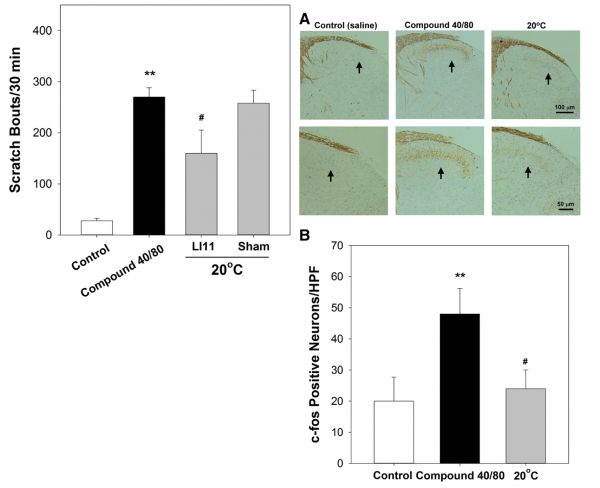 A gauche : Evaluating the antiprurtic efficacy of acupoint with a sham (non-acupoint) control.
A droite : c-fos expression in the cervical spinal cord. (A) Representative photomicrographs and (B) quantitative results of c-fos expression in the spinal cord. The c-fos-positive neurons were observed under a light microscope at high-power field (HPF) magnification, and the average number of c-fos-positive neurons was counted single-blind using the imaging software.BACKGROUND: Acupuncture and moxibustion are used to treat pruritus and atopic dermatitis. However, whether cold stimulation (defined as that the temperature conducted under skin temperature) of acupoints affects itching in experimental murine models remains unclear. METHODS: The present study was designed to determine the therapeutic effects of different thermal stimulations at the Quchi acupoint (LI11) in a murine model in which scratching behaviour was elicited by subcutaneous injection with a pruritogenic agent (compound 48/80). Male ICR mice were divided into several groups as follows: control (saline), those receiving compound 48/80 and compound 48/80 with various thermal stimulations (5°C-45°C) at LI11 (n = 6 per group). The scratch response of each animal to these stimulations was recorded for 30 min. The antipruritic effect of the acupoint was further evaluated in LI11 and sham (non-acupoint) groups (n = 6 per group). RESULTS: Treatment with lower temperature (20°C) at the LI11 acupoint significantly attenuated compound 48/80-induced scratching; however, this antipruritic effect was not observed with stimulation at the sham point. The expression of c-fos in the neuron of the cervical spine induced by compound 48/80 was suppressed by cold stimulation at LI11. The antipruritic effect of cold stimulation was blocked by ruthium red (RR), a non-selective transient receptor potential (TRP) channel blocker, suggesting that TRP channels may play an important role in the antipruritic effect of cold stimulation at LI11 in mice.CONCLUSIONS: This study demonstrated that cold stimulation at LI11 attenuated compound 48/80-induced scratching behaviour in mice, possibly by a TRP-related pathway.

- Bao Chun-Ling, Song Chun-Hua, Zhang Shu-Yuan. [Clinical Observation of 56 cases with Chronic Urticaria Treated with Acupuncturing on Quchi]. Journal of Clinical Acupuncture and Moxibustion. 2005;21(10):45. [183238]. Objective: To verify the specific therapeutic effect of Quchi in treating chronic urticaria. Methods :56 cases with chronic urticaria was divided randomly into two groups . Two groups were treated with the same medicine( cetirizine) , but the treatment group was combined with, acupuncture qt quchi . The clinic therapeutic effect was compared. Results: After 28 days treatment, symptoms( P < 0.05) and total clinic therapeutic effect ( P < 0.01) of treatment group was significantly improved than that in control group. Conclusion: Quchi point has the specific therapeutic effect in treating chronic urticaria.